
Is Fantasy Football Trade Worth It? Expert Insight on Trade Evaluators and Strategic Decision-Making
Fantasy football trades can make or break your season. Every trade decision carries weight—potentially elevating your roster from mediocre to championship-contending or, conversely, dismantling weeks of careful planning. The difference between a championship-winning team and one that limps into the playoffs often comes down to shrewd mid-season trades that capitalize on market inefficiencies, injury situations, and shifting player values. This comprehensive guide explores whether trades are truly worth pursuing, how to evaluate them scientifically, and when to pull the trigger on that offer sitting in your inbox.
The fantasy football community often debates whether trading should be a cornerstone strategy or approached with extreme caution. The truth lies somewhere in the middle—trades absolutely have value, but only when executed with proper analysis, clear understanding of your roster needs, and realistic assessment of player projections. By mastering the art of trade evaluation, you’ll transform from a passive team manager into an active architect of championship rosters. Let’s dive deep into the mechanics of fantasy football trading and discover how elite players separate themselves from the competition.
Understanding Trade Value Fundamentals
Trade value in fantasy football operates on a principle that’s simultaneously simple and complex: the perceived value of a player varies dramatically depending on roster context, league scoring format, and individual team needs. A running back averaging 15 points per week might be absolutely critical for one team while representing expendable depth for another. This fundamental disconnect creates trading opportunities for savvy managers who recognize when their surplus at one position can address critical shortages elsewhere.
The most successful fantasy football traders understand that perceived value differs from actual value. Your league’s consensus rankings represent the aggregate opinion of thousands of casual players—but the elite competitors dig deeper. They examine target share data, red zone touch percentages, upcoming strength of schedule, injury reports, and coaching changes. When a player’s true value diverges significantly from league perception, that’s when championship-caliber trades emerge.
Consider the concept of positional scarcity. If elite tight ends are scarce this season but running back depth is plentiful, a manager with three capable running backs and a mediocre tight end has tremendous leverage. They can package two mid-tier running backs to acquire a premium tight end from a team drowning in pass catchers but weak at running back. Both teams improve because both address their critical needs—this is the essence of mutually beneficial trades that don’t feel like one-sided robberies.

Trade Evaluator Tools and Metrics
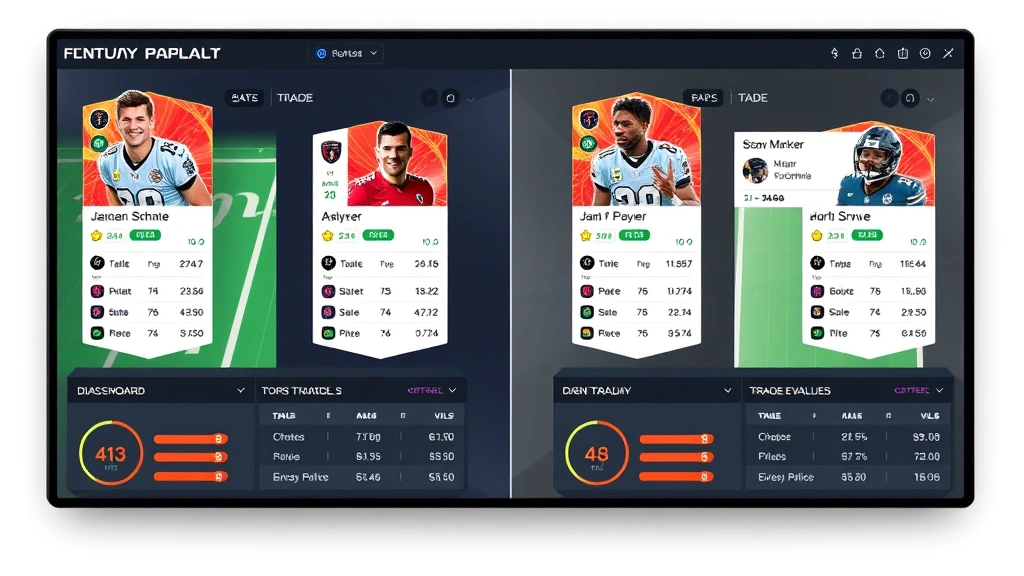
Modern fantasy football has evolved dramatically with the introduction of sophisticated trade evaluator tools that quantify player value using advanced metrics. Platforms like FantasyPros, ESPN’s trade analyzer, and specialized fantasy football sites provide baseline trade calculators that compare player values using consensus rankings and projected point totals. However, these tools represent a starting point, not gospel truth. They’re invaluable for identifying whether a proposed trade is roughly fair in isolation, but they don’t account for context—your specific league dynamics, playoff schedule strength, or your team’s championship probability before and after the trade.
The most comprehensive approach combines multiple valuation methodologies. PPR (Points Per Reception) scoring dramatically shifts value toward pass-catching backs and wide receivers, while standard scoring emphasizes touchdown-dependent players. Dynasty leagues value youth and future potential alongside immediate production, while redraft leagues focus purely on this season’s output. Understanding how your league’s specific scoring system influences player values is absolutely essential before accepting any trade.
Advanced metrics like Sports Science Research on player performance trends, air yards percentage, yards after catch, and snap count percentages provide deeper insight than surface-level statistics. A running back with 80 carries and 800 yards looks pedestrian until you discover he’s averaging 10 yards per carry—indicating exceptional efficiency that likely continues. Conversely, a wide receiver with 1,000 yards on 150 targets represents concerning inefficiency that may correct downward.
Utilize multiple exercise physiology and sports performance databases to understand injury recovery timelines and realistic return-to-play scenarios. A player expected to miss six weeks with a hamstring injury has dramatically different value than one expected to miss two weeks. These details separate informed trades from speculative gambles.
Assessing Your Roster Needs
Before evaluating any trade proposal, conduct an honest assessment of your roster’s weaknesses and strengths. Many fantasy managers become emotionally attached to their drafted players and resist trading them even when roster construction demands it. This emotional attachment costs championships.
Start by ranking your roster at each position relative to your league. If you drafted an elite wide receiver, you likely have depth at that position. Conversely, if you reached for a premium running back, your wide receiver corps probably needs strengthening. Identify your top three roster weaknesses—these are your trade targets. What would it take to upgrade at these positions? Which of your current players could you realistically trade away?
Next, examine your bench ruthlessly. Players sitting on your bench have zero value unless they’re lottery tickets with championship upside. A mediocre player contributing nothing toward your win total represents an asset that could be leveraged into meaningful production. Don’t fall into the trap of hoarding potential—trade bench depth for starting-caliber upgrades at positions of need.
Consider playoff schedule strength when assessing trades. A player with an easy playoff schedule becomes significantly more valuable in November than a player facing elite defenses during fantasy football’s most critical weeks. This timing advantage can swing trades in your favor if you identify these schedule disparities before league-wide consensus catches up.
Identifying Breakout Opportunities
Championship teams don’t just manage their current roster—they identify undervalued players poised for breakout performances and acquire them before market recognition. After reviewing our comprehensive guide on fantasy football draft strategy, you’ll understand how draft capital allocation influences mid-season perceptions.
Monitor coaching changes, offensive line improvements, and target share trends obsessively. A wide receiver whose team just traded away their top pass-catcher suddenly becomes the primary receiving option—his value should spike. A running back whose team fired their offensive coordinator and installed a new scheme emphasizing ground attack deserves your attention. These structural changes often take weeks for league consensus to acknowledge, creating trading windows where you can acquire breakout candidates at discount prices.
Handcuff analysis reveals hidden value. If your primary running back plays for a team with a backup averaging 4.0 yards per carry on limited touches, acquiring that backup represents championship insurance. Should injury strike, you’ve protected your investment. If the primary back stays healthy, the handcuff holds minimal value—but the insurance was worth the depth cost.
Follow beat reporters and coaching staff comments religiously. Coaches often telegraph upcoming role changes through offhand remarks in press conferences. A coach mentioning a backup’s impressive practice performance or discussing increased snap counts signals impending opportunity. Savvy traders pounce on these signals before the market catches up.
Common Trading Mistakes to Avoid
Even experienced fantasy managers fall into predictable trading traps. Understanding these mistakes prevents costly errors that undermine your championship aspirations. Learn from Peak Play Arena’s expert analysis on avoiding common pitfalls in competitive fantasy leagues.
The most dangerous mistake is overvaluing name recognition. A superstar who’s underperforming due to injury, usage decline, or defensive scheme changes tempts managers into overpaying. You’re not buying past glory—you’re buying future production. If a first-round pick has declined to flex-level value, accept the sunk cost fallacy and move on rather than compounding the mistake through unfavorable trades attempting to recoup draft capital.
Conversely, panic trading during downturns costs championships. A wide receiver with two consecutive sub-10-point performances might simply be experiencing normal variance. Trading him away for pennies on the dollar before a favorable upcoming schedule is a classic mistake. Give players opportunities to play through rough patches before abandoning them.
Never trade for speculative lottery tickets unless you’re already set at that position and have excess depth. Trading established production for potential is rarely worth the risk, especially mid-season when you need consistent output. Save speculation for waiver wire pickups where the cost is minimal.
Avoid trades that improve your immediate situation while weakening your playoff roster. A trade acquiring a player with an elite upcoming schedule but brutal playoff matchups backfires when fantasy football’s most critical weeks arrive. Think beyond next week—optimize your roster for late November and December performance.
Timing Your Trades Strategically
The best trades execute at specific windows when team circumstances align perfectly. A team that just suffered multiple injuries might desperately need depth, making them willing to trade established starters at discount prices. A team sitting in a playoff position with no realistic championship path might trade away future assets for immediate help—or sell high on veterans before decline accelerates.
The bye week period creates trading urgency. Managers desperate to fill lineups missing star players due to bye weeks often accept unfavorable trades just to field complete rosters. This desperation represents opportunity. If you’ve strategically managed your roster to avoid bye week crises, you can exploit other managers’ panic.
Trade deadline timing matters enormously. Early-season trades (Weeks 2-4) allow maximum time for acquired players to prove their value and integrate into your system. Mid-season trades (Weeks 6-8) balance urgency with sufficient remaining time. Late trades (Weeks 10-12) represent pure desperation moves by teams fighting for playoff spots—the desperation often leads to lopsided deals favoring the team in control.
Monitor league activity patterns. If multiple managers are making trades in a short window, a wave of activity might indicate league consensus is shifting. You can ride this wave or contrarian-trade against it depending on your situation.
Building a Championship Roster
Championship rosters rarely assemble perfectly through draft alone. Strategic trading transforms good teams into great ones by optimizing positional allocation and addressing unforeseen circumstances. Start by establishing your championship team archetype—are you building a balanced roster or stacking elite talent at specific positions? This philosophical approach guides your trading decisions.
Consider exploring our college football predictions to understand how upcoming NFL talent transitions might influence fantasy values as the season progresses. Understanding future draft classes helps you evaluate mid-season trades involving younger players with long-term value.
Build redundancy at positions of scarcity. If elite running backs are scarce, acquiring three capable backs provides insurance against injury while maximizing your positional strength. This depth becomes trade ammunition when you package two quality backs to upgrade another position. Conversely, avoid redundancy at positions where talent is plentiful—every league has ten capable wide receivers on waiver wires.
The championship equation balances consistency with ceiling. You need reliable week-to-week producers at your starting positions, but you also need players with playoff upside who can carry you through December. Trades should move you closer to this balance, acquiring consistent producers at positions of need while potentially trading away boom-or-bust players for more reliable options.
Remember that trading is ultimately about improving your championship probability. Every trade should meaningfully increase your odds of winning your league. If a proposed trade merely marginalizes changes to your playoff chances, skip it and preserve your roster stability.
FAQ
Should I trade my first-round pick if he’s underperforming?
Not immediately. First-round talent rarely disappears permanently—injuries and usage changes often prove temporary. Give underperforming studs 6-8 weeks before considering trades. However, if structural changes suggest lasting decline (coaching changes, offensive line collapse), trade sooner rather than later while you can still extract value.
What’s a fair trade ratio for different positions?
Position scarcity determines fair value. In a league where elite tight ends are rare, trading a mid-tier running back for a premium tight end represents fair value even if the running back averages more points. Use trade evaluator tools as baselines but adjust for positional scarcity and your specific team needs.
How do I know if a trade helps my playoff chances?
Project your team’s performance from Week 13-17 with and without the trade. Calculate your expected playoff points in both scenarios. If the trade meaningfully increases your projected playoff output, execute it. This mathematical approach removes emotion from decision-making.
Should I trade with teams I’m competing against?
Absolutely, if the trade improves your roster. Don’t make trades worse just to avoid helping competitors. Focus on maximizing your own team’s championship probability rather than minimizing others’ chances. Fair trades benefit both teams.
When is the latest I should trade?
Most leagues allow trades through Week 10 or 11. Don’t wait until the final deadline—you need weeks for acquired players to prove their value. Make significant trades by Week 8 to ensure sufficient integration time.


