Improve Soccer Fitness: Pro Tips for Players to Dominate the Field
Soccer demands explosive power, sustained endurance, and tactical intelligence—all wrapped into 90 minutes of non-stop action. Whether you’re a weekend warrior or aspiring professional, your fitness level directly determines your on-field performance, injury resilience, and competitive edge. Elite footballers aren’t born; they’re built through strategic conditioning, intelligent training periodization, and unwavering commitment to physical excellence.
The modern game has evolved dramatically. Players now cover 10-13 kilometers per match, execute 1,000+ technical actions, and face unprecedented physical demands. Your fitness foundation isn’t optional—it’s the cornerstone of soccer success. This comprehensive guide reveals science-backed strategies that professional clubs use to transform ordinary players into extraordinary athletes.
Building Aerobic Capacity for Match Endurance
Aerobic fitness forms the metabolic foundation for soccer performance. Your aerobic system delivers oxygen-rich blood to working muscles throughout the match, enabling sustained effort during the second half when fatigue typically strikes. Research from the American College of Sports Medicine (ACSM) demonstrates that elite soccer players maintain VO2 max levels between 55-65 ml/kg/min—significantly higher than untrained populations.
Developing your aerobic engine requires strategic periodization:
- Steady-state running (70-80% max heart rate): Complete 45-60 minute sessions twice weekly at conversational pace. This builds capillary density, mitochondrial efficiency, and aerobic enzyme activity without excessive central nervous system fatigue.
- Tempo runs (85-90% max heart rate): Sustain harder efforts for 20-30 minutes once weekly. These sessions improve your lactate threshold—the intensity where your body transitions from aerobic to anaerobic metabolism.
- Long slow distance (60-70% max heart rate): Monthly 90-120 minute sessions build mitochondrial density and fat oxidation capacity, valuable for the grind of competitive seasons.
Soccer-specific aerobic training trumps generic running. Incorporate football training equipment into conditioning circuits: shuttle runs, figure-eight patterns, and variable-pace intervals that mimic match demands. Your cardiovascular adaptations will transfer directly to game performance.
Practical implementation: Use heart rate zones or perceived exertion scales to monitor intensity. Invest in a sports watch that tracks training load metrics. Consistency beats intensity—three solid weeks of moderate aerobic work outperforms sporadic high-intensity efforts.
Developing Anaerobic Power and Sprint Speed
Soccer erupts in explosive moments: sprinting to intercept passes, accelerating past defenders, executing powerful shots. Your anaerobic system powers these decisive actions. While aerobic capacity sustains performance, anaerobic power creates match-winning moments.
High-intensity interval training (HIIT) protocols deliver superior results:
- 30-30 intervals: Sprint 30 seconds at maximum effort, recover 30 seconds at easy pace. Repeat 8-10 rounds, 1-2 times weekly. This format closely mirrors soccer’s variable-intensity demands.
- Repeated sprint ability (RSA): Execute 6-10 maximal 5-10 second sprints with 20-30 second recovery between efforts. RSA predicts match performance better than single-sprint speed in scientific literature.
- Hill sprints: 6-8 x 40-meter uphill sprints with walk-down recovery. Hill training builds explosive leg power while reducing joint impact compared to flat-surface sprinting.
Recovery between high-intensity sessions matters tremendously. Never perform two maximal anaerobic sessions consecutively—your central nervous system requires 48-72 hours for full recovery. Space HIIT work across the training week with aerobic and strength sessions between efforts.
Technical execution during fatigue separates elite players from average ones. Incorporate ball work into sprint intervals: receive passes, perform quick directional changes, or execute shots after high-intensity efforts. This trains your nervous system to maintain technical precision when fatigued—exactly what matches demand.
Strength Training: The Hidden Performance Multiplier
Strength isn’t bulky muscles; it’s contractile force that powers acceleration, jump height, and injury resistance. Professional soccer clubs dedicate 2-3 weekly sessions to structured strength work because research confirms its impact on sprint speed, vertical jump, and injury prevention.
Lower body strength priorities:
- Squat variations (back squat, front squat, goblet squat): Build comprehensive lower body strength. Perform 3-4 sets of 5-8 repetitions at 80-85% of one-rep max. Squats develop quadriceps, glutes, and stabilizer muscles essential for kicking power and landing stability.
- Deadlift variations (conventional, sumo, trap bar): Strengthen posterior chain muscles (hamstrings, glutes, lower back) critical for sprint acceleration and injury prevention. Execute 3 sets of 5-6 repetitions twice weekly.
- Unilateral exercises (split squats, Bulgarian split squats, single-leg Romanian deadlifts): Soccer demands single-leg stability during kicking and directional changes. Perform 3 sets of 8-10 repetitions per leg.
- Plyometric work (box jumps, bounding, single-leg hops): Translate strength into explosive power. Execute 3-4 sets of 5-8 repetitions, 1-2 times weekly on fresh legs.
Core strength underpins all soccer movements. Your core stabilizes your spine during acceleration, deceleration, and rotational movements. Implement 2-3 weekly core sessions featuring dead bugs, pallof presses, bird dogs, and anti-rotation exercises for 3 sets of 10-15 repetitions.
Upper body shouldn’t be neglected: Shoulder stability, chest strength, and core integration matter for balance, aerial challenges, and injury resilience. Include horizontal pulls (rows), horizontal pushes (push-ups, bench press), and vertical pulling (pull-ups) movements twice weekly.
Progressive overload drives strength gains. Track your lifts in a training log, increasing weight or repetitions weekly. Strength improvements plateau without systematic progression. Many players find proper conditioning to avoid sports injuries correlates directly with consistent strength training.
Agility, Coordination, and Lateral Movement
Soccer isn’t linear—it’s multidirectional chaos. Your ability to change direction explosively, maintain balance through lateral movements, and coordinate complex motor patterns under pressure separates competent players from elite performers.
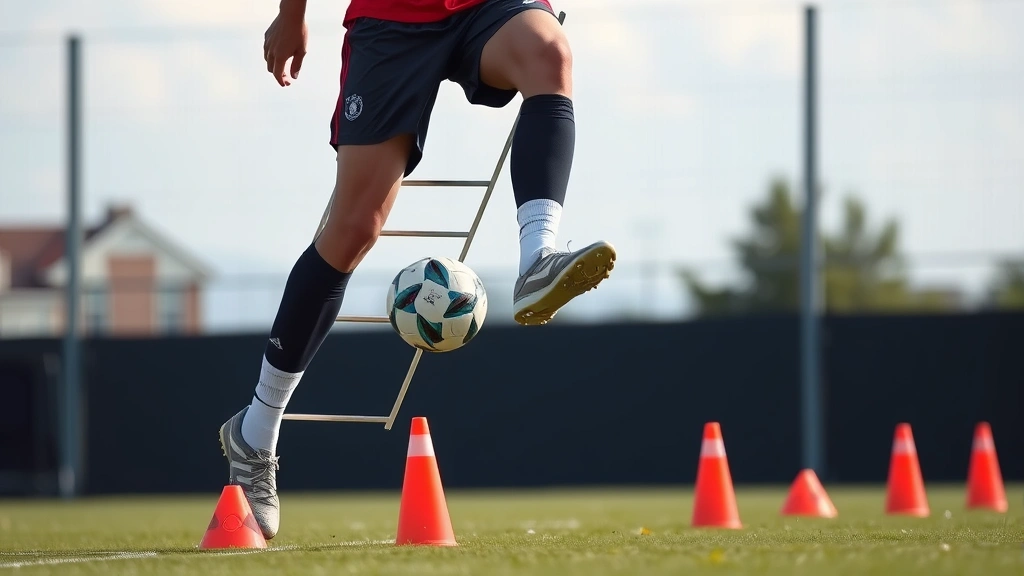
Agility ladder drills (2x weekly, 10-15 minutes):
- Single-foot hops through ladder squares
- Lateral shuffle patterns with directional changes
- Diagonal crossover steps
- High-knee running with rapid directional shifts
These drills enhance neuromuscular coordination, foot speed, and proprioceptive awareness. Perform them fresh before main training sessions when your nervous system is optimally responsive.
Change-of-direction speed (COD) training: Execute sport-specific patterns: T-drills, 5-10-5 shuttle runs, and zigzag sprints. Research demonstrates that COD speed predicts soccer performance more accurately than straight-line sprint speed. Include 1-2 COD sessions weekly featuring 6-10 repetitions of different patterns with full recovery between efforts.
Balance and proprioceptive work: Single-leg stance holds, balance board exercises, and single-leg deadlifts enhance ankle stability and proprioceptive awareness. These exercises significantly reduce ankle injury risk—the most common soccer injury. Perform 2-3 sets of 15-30 second holds or 10-12 repetitions, 3-4 times weekly.
Coordinate these drills with sports team bonding activities to keep training engaging and mentally fresh. Group agility competitions build camaraderie while maintaining training quality.

Recovery, Nutrition, and Periodization Strategy
Training stimulus creates the opportunity for adaptation; recovery enables it. Elite athletes understand that progress happens between sessions, not during them. Neglecting recovery sabotages your fitness gains regardless of training excellence.
Sleep optimization (non-negotiable): Target 8-9 hours nightly. Sleep deprivation impairs glycogen replenishment, hormone balance, and neuromuscular recovery. Professional clubs enforce strict sleep protocols because research confirms sleep’s direct impact on match performance and injury risk.
Nutrition strategy for soccer fitness:
- Carbohydrate periodization: High-carb days (5-7g/kg body weight) follow intense training or matches for glycogen repletion. Moderate-carb days (3-5g/kg) accompany lighter sessions. This approach optimizes energy availability while managing body composition.
- Protein consistency (1.6-2.0g per kg body weight daily): Supports muscle protein synthesis and adaptation. Distribute intake across 4-5 meals for optimal muscle building.
- Micronutrient adequacy: Iron (oxygen transport), magnesium (muscle function), and vitamin D (bone health) require special attention. Most players benefit from comprehensive blood work to identify deficiencies.
- Hydration protocol: Drink 500-600ml fluid 2-3 hours before training, 200-300ml 15-20 minutes before exercise, and 150-200ml every 15-20 minutes during activity. Post-exercise, consume 150% of fluid lost through sweat over 4-6 hours.
Periodization framework (the master plan):
Elite soccer clubs structure training into macrocycles (4-week blocks), mesocycles (specific training phases), and microcycles (weekly plans). This systematic approach prevents overtraining, manages fatigue, and peaks performance for competitions.
- Preparation phase (8-12 weeks pre-season): Build aerobic base, develop strength, and improve technical fundamentals. Training volume peaks here; intensity remains moderate.
- Competition phase (in-season): Maintain fitness while emphasizing match-specific intensity. Volume decreases; intensity and technical quality increase. Include tactical training and match simulations.
- Transition phase (post-season): Active recovery, psychological restoration, and addressing individual weaknesses. Training volume and intensity drop significantly.
Within competition phases, implement microcycles strategically. If your match occurs Saturday, structure the week: Monday (recovery/light technical work), Tuesday-Wednesday (high-intensity sessions), Thursday (tactical emphasis), Friday (activation/technical sharpness), Saturday (match). This pattern maintains fitness while managing fatigue for optimal match performance.
Visit our Peak Play Arena Blog for detailed periodization templates and seasonal planning guides.
FAQ
How many days per week should I train for soccer fitness?
Elite players typically train 5-6 days weekly, combining team sessions, individual conditioning, and recovery work. Recreational players benefit from 3-4 dedicated fitness sessions weekly alongside regular team practice. Quality trumps quantity—three focused sessions outperform six unfocused efforts.
What’s the ideal balance between aerobic and anaerobic training?
Approximately 70-80% of training should emphasize aerobic capacity with moderate intensity, while 20-30% focuses on high-intensity anaerobic work. This distribution reflects soccer’s metabolic demands: the majority of match time involves aerobic effort with intermittent anaerobic bursts.
Can I improve soccer fitness without a gym?
Absolutely. Bodyweight exercises, resistance bands, and outdoor running create excellent fitness improvements. However, structured strength training with progressive loading accelerates gains. Consider investing in basic equipment or accessing affordable fitness facilities.
How long until I notice fitness improvements?
Initial adaptations appear within 2-3 weeks (nervous system adjustments). Significant aerobic improvements require 6-8 weeks of consistent training. Strength gains and substantial performance changes typically manifest over 8-12 weeks. Patience and consistency trump sporadic intensity.
Should I do fitness training on match days?
No. Match days require complete rest or very light recovery activities (walking, gentle stretching). Your body needs maximal resources for match performance. Save conditioning work for non-match days when recovery capacity is available.
How does football training equipment enhance fitness development?
Specialized equipment like agility cones, speed ladders, and resistance sleds adds variety, increases engagement, and enables precise stimulus manipulation. While not essential, quality equipment accelerates skill-fitness integration and maintains training motivation.
What’s the relationship between strength training and injury prevention?
Research confirms that players with superior strength, particularly in the posterior chain and core, experience significantly fewer injuries. Strength training improves tissue resilience, movement quality, and neuromuscular control—all critical injury prevention factors. Incorporating strategies to avoid sports injuries with your strength program creates comprehensive injury resilience.
How do I know if I’m overtraining?
Warning signs include persistent fatigue, elevated resting heart rate, decreased performance, mood disturbances, and recurrent minor illnesses. Track your training load using perceived exertion scales or wearable technology. If warning signs appear, reduce volume 20-30% and prioritize sleep and nutrition for 7-10 days.


