
Football Goal Post Workouts: Coach Insights for Peak Performance
The football goal post stands as one of the most underutilized training tools in athletic development. While most coaches focus on traditional conditioning drills and field work, innovative strength and conditioning professionals recognize that goal post training offers unique benefits for explosive power, vertical jump ability, and functional strength. This comprehensive guide reveals how elite coaches integrate goal post workouts into their training programs to develop superior athletes who dominate on game day.
Whether you’re a high school football coach, college strength and conditioning specialist, or dedicated athlete seeking competitive advantage, goal post workouts provide measurable improvements in athletic performance. The vertical structure, adjustable heights, and stability of goal posts create opportunities for plyometric training, resistance work, and agility development that traditional equipment cannot replicate. Understanding these specialized training methods separates programs that merely compete from those that consistently win championships.
Why Goal Post Training Transforms Athletic Development
Goal post workouts represent a paradigm shift in how we approach functional fitness for football players. Unlike isolated weight room exercises, goal post training demands that athletes move through space, engage stabilizer muscles, and develop the explosive power necessary for game situations. The vertical nature of goal posts directly translates to improved jumping ability, which correlates with enhanced defensive coverage, receiver separation, and overall athletic explosiveness.
Research from exercise physiology demonstrates that training with unstable or variable resistance—such as pulling, jumping, and climbing on goal posts—activates greater muscle recruitment patterns than traditional barbell exercises alone. This activation engages the central nervous system more effectively, leading to faster neural adaptation and improved performance transfer to competition. When athletes train on goal posts, they’re not just building muscle; they’re rewiring their neuromuscular system for explosive, coordinated movement.
The psychological component shouldn’t be overlooked either. Goal post training feels challenging, looks impressive, and creates a sense of accomplishment that motivates athletes to push harder. This mental toughness developed during goal post sessions translates directly to competitive resilience on Friday nights or Sunday afternoons. Athletes who regularly train on goal posts develop confidence in their physical capabilities that manifests as superior performance under pressure.
Many successful programs now incorporate goal post training as a cornerstone of their conditioning philosophy. The accessibility of goal posts—virtually every football field has them—means no special equipment investment is required. Smart coaches recognize this opportunity and leverage goal posts as a cost-effective tool for developing the explosive, powerful athletes their programs demand.

Essential Goal Post Workout Protocols
Establishing proper protocols ensures safety and maximizes training effectiveness. Before implementing goal post workouts, athletes must demonstrate adequate baseline strength, mobility, and body awareness. Improving hand-eye coordination and grip strength provides foundational capabilities necessary for safe goal post training execution.
The foundational protocol begins with hanging exercises that build grip strength and shoulder stability:
- Dead Hangs: Athletes grip the crossbar with both hands and hang for progressive duration (starting 20 seconds, building to 60+ seconds). This develops grip endurance and decompresses the spine after heavy lifting.
- Single-Arm Hangs: Progress to single-arm variations that demand significant core stability and unilateral shoulder strength. Perform for 15-30 seconds per side.
- Alternating Leg Raises: While hanging, raise legs alternately to hip height, developing core strength and hip flexor power essential for kicking and running mechanics.
- Explosive Pull-Up Variations: Standard pull-ups transition to explosive versions where athletes pull aggressively, potentially releasing the bar momentarily before re-gripping.
These foundational movements prepare the body for more advanced goal post training. Athletes should master hanging mechanics before progressing to climbing or dynamic movements. Proper hand positioning, shoulder engagement, and core bracing prevent injury while maximizing training stimulus.
Check your football gloves fit and grip quality when training on goal posts, as proper equipment enhances safety and performance during these demanding workouts.
Plyometric Excellence Through Goal Post Drills
Plyometric training on goal posts develops the explosive power that separates elite athletes from average performers. Goal post plyometrics bridge the gap between strength development and sport-specific speed, creating athletes who explode off the line and dominate every snap.
Vertical Jump Progressions using Goal Posts:
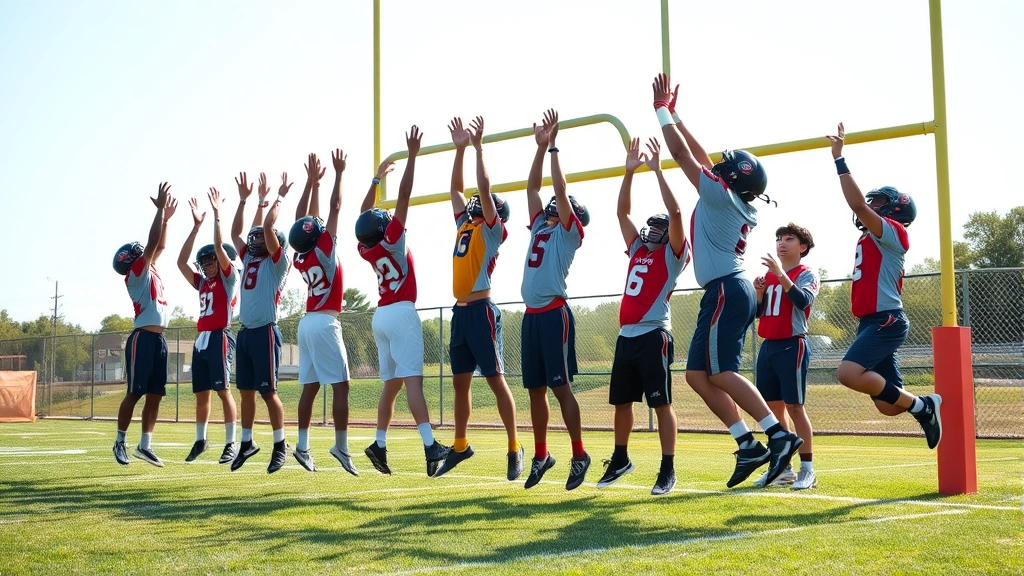
- Two-Foot Jump Reaches: Athletes stand beneath the crossbar and jump vertically, attempting to touch the bar. Record maximum height and track progression weekly. This directly measures vertical jump improvement and provides immediate performance feedback.
- Single-Leg Hop Reaches: Progress to single-leg variations that develop unilateral power and identify strength imbalances between legs. Perform 5-8 hops per leg, resting 90 seconds between sets.
- Bounding Approach Jumps: Athletes take 2-3 approach steps before jumping explosively to touch the goal post. This mimics game situations where athletes rarely jump from stationary positions.
- Lateral Jump Reaches: Jump sideways toward the goal post, developing frontal plane power essential for defensive cuts and lateral movement patterns.
The goal post provides constant visual feedback—athletes immediately see whether they touched the target. This psychological reinforcement drives greater effort and allows coaches to document objective progress. Unlike abstract conditioning metrics, touching the goal post represents tangible achievement.
Advanced plyometric progressions include medicine ball throws against the goal post structure, explosive pull-up variations, and combination movements that develop power through multiple planes simultaneously. These variations prevent adaptation plateaus and challenge athletes to continually improve.
Strength Building Strategies Using Goal Posts
While plyometrics emphasize speed, goal post training also develops substantial strength gains. The eccentric (lowering) phase during pull-ups creates significant mechanical tension that drives muscle growth and strength development. Team-based goal post strength challenges build camaraderie while pushing individual athletes toward greater strength achievements.
Resistance Variations for Goal Post Strength Training:
- Weighted Pull-Ups: Athletes wear weighted vests or belts to increase resistance during pull-ups. Progress from bodyweight variations (8-12 reps) to weighted versions (5-8 reps) that build pure strength.
- Isometric Holds: Athletes pull themselves to chin-over-bar position and hold for 30-60 seconds. This develops incredible pulling strength and mental toughness.
- Eccentric-Emphasis Pull-Ups: Athletes jump to chin-over-bar position, then lower themselves over 5-10 seconds. The extended eccentric phase creates maximum muscle damage and growth stimulus.
- L-Sit Holds: From hanging position, athletes raise legs to horizontal and maintain that position. This develops core strength, hip flexor power, and stability.
The Peak Play Arena Blog regularly features advanced training methodologies that coaches can implement immediately to enhance their programs’ effectiveness.
These strength protocols typically utilize lower repetition ranges (3-8 reps) with maximum intensity. Rest periods extend to 2-3 minutes between sets, allowing nervous system recovery and ensuring athletes can maintain quality throughout the session. Progressive overload—consistently increasing difficulty—drives continuous strength adaptation.
Sport-Specific Movement Patterns
Elite coaching separates goal post training from generic strength work by emphasizing sport-specific movement patterns. Every exercise should develop qualities directly applicable to football performance. Goal post workouts must reinforce the explosive, powerful movements that define successful football athletes.
Defensive-Specific Goal Post Training:
Defensive backs benefit tremendously from goal post training that develops vertical jumping ability and explosive lateral movement. Corner backs and safeties who train goal post reach exercises develop superior coverage skills and increased interception opportunities. Linebacker goal post training emphasizes explosive pull-ups that build the pulling power necessary for shedding blocks and pursuing ball carriers through congestion.
Offensive-Specific Goal Post Training:
Wide receivers and tight ends utilize goal post training to develop the explosive vertical jump necessary for contested catch situations. The combination of jumping drills and upper body strength development creates receivers who consistently win jump-ball situations. Running backs benefit from single-leg hop progressions that develop the unilateral power necessary for cutting and changing direction with the football.
Linemen—both offensive and defensive—use goal post training to develop the explosive pulling power and grip strength that dominates at the point of attack. Heavy eccentric pull-ups and isometric holds build the absolute strength necessary to move 300-pound opponents.
These sport-specific applications ensure that goal post training transfers directly to game performance. Rather than training in isolation, athletes develop qualities that immediately impact their position-specific responsibilities.
Programming Goal Post Workouts Into Your Season
Effective programming integrates goal post training strategically throughout the football season. Off-season training emphasizes high volume, building the strength foundation necessary for in-season performance. Understanding football fundamentals extends beyond drawing diagrams—it includes understanding how training supports game performance.
Off-Season Programming (12 weeks):
- Weeks 1-4 (Strength Emphasis): 2-3 goal post sessions weekly, emphasizing weighted pull-ups and eccentric variations. Perform 4-5 sets of 5-8 reps with 2-3 minute rest intervals.
- Weeks 5-8 (Power Development): Maintain strength work with one session weekly, add two plyometric sessions emphasizing jump reaches and explosive variations. Perform 3-4 sets of 5-8 explosive repetitions.
- Weeks 9-12 (Maintenance with Sport-Specific Emphasis): One strength session, one power session weekly. Add sport-specific movement patterns that reinforce position demands.
In-Season Programming (16 weeks):
- Early Season (Weeks 1-4): One goal post session weekly, emphasizing maintenance of strength and power qualities. Perform 2-3 sets of 5-6 reps with 2-minute rest intervals. Keep volume moderate to avoid overtraining amid game preparation.
- Mid-Season (Weeks 5-12): Reduce to one goal post session every 10 days. Focus on explosive variations that maintain power output without excessive fatigue.
- Late Season (Weeks 13-16): Minimal goal post training, focusing on maintenance. One session every 2 weeks with 2-3 sets of 3-5 reps at high intensity.
This periodized approach prevents overtraining while maintaining the strength and power qualities developed during off-season training. The key is recognizing that in-season training serves maintenance and recovery purposes rather than building new capabilities.
Recovery protocols become increasingly important during in-season training. Ensure adequate sleep (8-10 hours nightly), proper nutrition with emphasis on protein and carbohydrate intake, and strategic rest days. Goal post training creates significant neural and muscular demand; insufficient recovery undermines performance and increases injury risk.
Advanced Techniques From Elite Coaches
Championship programs employ sophisticated goal post training methodologies refined through years of experimentation and athlete feedback. These advanced techniques separate elite programs from those merely going through the motions.
Complex Training Protocols: Elite coaches utilize complex training—pairing heavy strength work with explosive plyometric variations. For example, athletes perform 3-5 heavy weighted pull-ups, rest 30 seconds, then immediately perform explosive jump reaches. This post-activation potentiation effect enhances nervous system activation and creates superior power development compared to either modality alone.
Cluster Sets: Rather than performing all repetitions consecutively, cluster sets break volume into smaller clusters separated by brief rest intervals. An athlete might perform 2 pull-ups, rest 15 seconds, perform 2 more pull-ups, rest 15 seconds, repeat. This approach maintains quality while accumulating substantial volume.
Contrast Training: Pairing opposing movement patterns develops balanced strength and prevents injury. Combine heavy pull-ups with explosive push-ups or medicine ball chest throws. This develops complementary strength patterns that reinforce proper movement mechanics.
Tempo Training: Controlling movement speed amplifies training stimulus. A 5-second eccentric pull-up (lowering phase) creates tremendous muscle damage and growth stimulus. Athletes lower slowly and deliberately, maximizing time under tension while building eccentric strength that prevents injury.
Metabolic Conditioning Variations: Advanced programs combine goal post training with metabolic stress. Athletes perform timed goal post circuits—as many pull-ups as possible in 5 minutes, rest 2 minutes, jump reaches for time, repeat. This develops the mental toughness and work capacity that distinguishes champions.
These advanced techniques require proper progression and should only be implemented after athletes master foundational protocols. Attempting advanced techniques prematurely increases injury risk and may discourage athletes through excessive difficulty.
Successful coaches also recognize individual variation in response to training. Some athletes respond better to higher volume, others to higher intensity. Monitoring performance metrics—tracking pull-up numbers, vertical jump measurements, and subjective effort ratings—allows coaches to tailor programming to individual athlete needs while maintaining team-wide standards.
Check the latest research from the American College of Sports Medicine for evidence-based training recommendations that support goal post programming decisions.
The National Strength and Conditioning Association provides comprehensive coaching certifications that deepen understanding of periodization, exercise physiology, and advanced training methodologies applicable to goal post programming.
Tracking high school football scores provides context for understanding how training methodologies correlate with competitive outcomes, helping coaches refine their approaches based on results.
Research published in the Journal of Strength and Conditioning Research documents the effectiveness of plyometric training, vertical jump development, and strength-power transfer in athletic populations. Coaches who stay current with peer-reviewed literature make informed decisions that optimize athlete development.
FAQ
How often should athletes perform goal post workouts?
Off-season training typically incorporates 2-3 goal post sessions weekly, allowing adequate recovery between sessions. In-season training reduces frequency to 1 session weekly or every 10 days, prioritizing game preparation and recovery. The exact frequency depends on individual athlete response, training age, and overall program structure.
What age should athletes begin goal post training?
Athletes should demonstrate baseline upper body strength and body awareness before beginning goal post training. Generally, high school-aged athletes (14+) with adequate strength foundation can safely perform goal post workouts under proper supervision. Middle school athletes may begin with modified protocols emphasizing hanging and bodyweight pull-ups before progressing to more advanced variations.
Can goal post training prevent injury?
Properly executed goal post training strengthens muscles, tendons, and connective tissues, reducing injury risk. The emphasis on eccentric strength and stability particularly protects shoulders and upper back. However, improper progression or excessive volume can increase injury risk. Always prioritize proper movement mechanics and gradual progression.
How do I track progress in goal post training?
Objective metrics include maximum pull-up repetitions, weighted pull-up performance, vertical jump height (measured from standing reach to jumping reach), and time held in isometric positions. Track these metrics every 4 weeks, documenting progression throughout the training cycle. Video analysis of movement quality provides qualitative assessment complementing quantitative metrics.
Should all positions perform identical goal post workouts?
While foundational protocols remain consistent, elite programs modify exercises to emphasize position-specific demands. Linemen emphasize heavy eccentric pull-ups and isometric holds developing absolute strength. Skill position players emphasize jump reaches and explosive variations developing power. This position-specific customization maximizes transfer to game performance.
What external resources provide evidence-based goal post training information?
The American Council on Exercise offers resources on exercise physiology and program design. Academic journals including the Journal of Strength and Conditioning Research publish peer-reviewed studies on plyometric training, vertical jump development, and strength-power transfer applicable to goal post programming.


