
Boost Stamina for Football: Coach Insights to Dominate Every Game
When the fourth quarter rolls around and your legs feel like cement, that’s when champions separate from the rest. Football demands explosive power, tactical intelligence, and most critically—elite stamina that carries you through 60 minutes of relentless competition. Whether you’re grinding through practice or executing crucial plays in the final moments, your cardiovascular capacity and muscular endurance determine whether you finish strong or fade away.
Coaches across the nation consistently identify stamina deficiencies as the primary performance limiter among competitive football players. A study from the American College of Sports Medicine revealed that athletes with superior aerobic capacity maintain 15-20% higher performance metrics in the final quarter compared to their stamina-deficient counterparts. This isn’t about natural talent—it’s about strategic training.
This comprehensive guide breaks down proven coaching methodologies, evidence-based training protocols, and real-world strategies that elite football programs use to build unstoppable stamina. You’ll discover exactly what separates players who dominate from those who struggle when it matters most.
Understanding Football-Specific Stamina Demands
Football isn’t like running a marathon or cycling for hours. It’s a sport of repeated explosive efforts separated by brief recovery windows. Your stamina requirements differ fundamentally from endurance athletes—you need the ability to produce maximum effort repeatedly, recover quickly, and maintain decision-making quality under fatigue.
Professional football players average 50-80 high-intensity efforts per game, with average work-to-rest ratios around 1:3 to 1:5 depending on position. A defensive lineman might explode off the line 40-60 times per game, while a wide receiver performs 15-25 intense sprints. This creates unique physiological demands: you’re not building pure aerobic endurance but rather repeated-sprint ability combined with positional-specific demands.
Research from the Journal of Sports Sciences demonstrates that football-specific stamina requires three integrated energy systems: the phosphocreatine system (0-10 seconds), anaerobic glycolytic system (10-90 seconds), and aerobic system (90+ seconds). Most game situations demand seamless transitions between these systems.
Understanding your position’s specific demands is crucial. Offensive linemen need sustained power and recovery between plays, while defensive backs require repeated maximal-effort sprints with minimal rest. Tailoring your stamina program to these demands dramatically increases effectiveness.
High-Intensity Interval Training for Football Performance
HIIT isn’t just a buzzword—it’s the single most effective method for building football-specific stamina. Unlike steady-state cardio, interval training replicates the exact energy demands of competition: maximal effort followed by incomplete recovery.
The Yo-Yo Intermittent Recovery Test Protocol has become the gold standard for evaluating football stamina. This protocol involves 20-meter sprints with 10-second recovery periods, progressively increasing speed until failure. Elite college and professional programs use this exact framework to design training interventions.
A highly effective HIIT protocol for football bros involves:
- 30-second maximum-effort sprints followed by 90-second active recovery (light jog)
- Repeat for 8-10 rounds (total 16-20 minutes of work)
- Perform 2-3 times weekly with 48-hour recovery between sessions
- Progress by reducing recovery time or increasing sprint duration
Research from National Strength and Conditioning Association shows that athletes performing this exact protocol improved repeated-sprint ability by 12-18% within 6 weeks. More importantly, they maintained power output in the final quarter—exactly when games are decided.
The physiological adaptations are profound: improved lactate buffering capacity, enhanced mitochondrial density, and increased capillarization in working muscles. These aren’t just numbers—they translate directly to better performance when you’re exhausted in the fourth quarter.
Building Aerobic Capacity Without Sacrificing Speed
Many football players fear traditional cardio will make them “slow.” This misconception costs them valuable stamina. The key is building aerobic capacity through methods that preserve explosive power and speed.
Zone 2 Training has emerged as the optimal approach. This involves sustained efforts at 60-70% maximum heart rate for 30-60 minutes, performed 1-2 times weekly. At this intensity, you’re building aerobic capacity and mitochondrial efficiency without triggering the muscle-wasting effects of excessive steady-state cardio.
Combine Zone 2 training with tempo efforts: 15-20 minute blocks at 80-85% maximum heart rate. This intermediate intensity builds lactate threshold—the point where your body can no longer clear lactate as quickly as it accumulates. Higher lactate threshold means better performance during high-intensity game situations.
For football-specific aerobic development, incorporate:
- Long-distance interval circuits: 400-meter runs at 85% effort with 60-90 second recovery, 4-6 repetitions
- Continuous tempo runs: 20-30 minutes at conversational pace (approximately 75% max HR)
- Sport-specific conditioning: Position-specific movements at controlled intensities
The beauty of this approach: you’re building the aerobic foundation that enables repeated high-intensity efforts while maintaining the speed and explosiveness that defines elite football performance.

” alt=”Football player performing sprint training on field during sunset”/>
Sport-Specific Conditioning Drills Coaches Recommend
Generic conditioning won’t cut it. Elite coaches implement sport-specific drills that build stamina while reinforcing football skills and tactical understanding. These drills are superior because they train your nervous system for game-realistic situations while simultaneously building stamina.
The “Pursuit Drill” is favored by defensive coordinators nationwide. Players line up across the field, sprint 20 yards, plant and change direction, sprint 20 yards perpendicular, then sprint 20 yards back. This replicates defensive pursuit angles while demanding repeated explosive efforts with directional changes. Perform 6-8 rounds with 45-60 second recovery.
“Route Tree Conditioning” for receivers and backs involves executing full-speed routes from your playbook with 30-second work intervals and 30-second recovery. Run 8-10 routes consecutively, maintaining perfect form despite fatigue. This builds stamina while reinforcing muscle memory for game situations.
“Line of Scrimmage Explosivity” for linemen: From a three-point stance, explode forward against resistance for 6 seconds, recover for 6 seconds, repeat 10 times. Immediately follow with a 40-yard sprint. Complete 4-5 rounds. This develops the specific stamina demands of line play—repeated explosive efforts with minimal recovery.
Position coaches emphasize that these drills produce superior results because they’re contextually relevant. Your body adapts specifically to the demands you impose upon it. If you condition like a linebacker, you’ll have linebacker stamina. Generic treadmill work doesn’t build game-winning stamina.
Nutrition and Recovery: The Stamina Foundation
Stamina training is only half the equation. Without proper nutrition and recovery, you’re leaving 50% of potential gains on the table. Your body builds stamina during recovery, not during training. Elite programs treat nutrition as seriously as they treat conditioning.
Carbohydrate timing is critical. Your muscles store glycogen—the primary fuel for high-intensity efforts. During intense conditioning sessions, you’re depleting these stores. Consuming carbohydrates within 30 minutes post-training replenishes glycogen and accelerates recovery. Research recommends 1.0-1.2 grams of carbohydrate per kilogram of body weight within this window.
For a 200-pound football player, this means approximately 90-110 grams of carbohydrates post-workout. Pair this with 20-30 grams of protein to stimulate muscle protein synthesis. This combination is scientifically proven to improve recovery metrics and stamina development.
Hydration demands increase dramatically during stamina training. Studies show that even 2% dehydration impairs performance and recovery. Football athletes should consume 16-24 ounces of fluid for every pound lost during training. For a two-hour practice where you lose 3-4 pounds, this means 48-96 ounces of fluid post-practice.
Don’t overlook micronutrients. Iron, magnesium, and B-vitamins are essential for energy production and recovery. Deficiencies in these nutrients can severely limit stamina development. Incorporating nutrient-dense whole foods—lean meats, vegetables, legumes, whole grains—ensures you’re providing your body the building blocks for optimal adaptation.
Sleep is where the magic happens. During deep sleep, your body releases growth hormone, repairs muscle tissue, and consolidates neural adaptations from training. Elite performers prioritize 8-9 hours nightly. Athletes sleeping less than 7 hours show 26% reduced stamina improvements compared to those sleeping 8+ hours, according to research from the American Academy of Sleep Medicine.
Position-Specific Stamina Strategies
While general stamina principles apply universally, position-specific demands require tailored approaches. Understanding your defensive position or offensive role ensures your training directly targets game demands.
Defensive Linemen and Linebackers require sustained power and repeated explosivity. Their stamina training emphasizes strength-endurance circuits combining resistance training with minimal rest. Heavy compound movements (squats, deadlifts) performed with 45-60 second rest periods build the specific stamina these positions demand.
Defensive Backs and Wide Receivers need repeated maximal-speed efforts with rapid directional changes. Their conditioning focuses on sprint-based HIIT: 40-60 yard sprints at maximum velocity with 45-90 second recovery. This directly replicates coverage demands and route running requirements.
Offensive and Defensive Linemen face unique demands: explosive first steps followed by sustained blocks or resistance. Their conditioning combines plyometric explosivity with longer-duration efforts. Sled pushes, prowler work, and sustained low-position holds build the specific stamina these positions demand.
Running Backs and Tight Ends require versatile stamina: explosive cuts, sustained blocks, and repeated short-burst accelerations. Their conditioning incorporates multi-directional agility drills, shuttle runs, and cone-based circuits that develop omnidirectional stamina.
The principle is straightforward: train the specific movements and energy systems your position demands. Doing so ensures maximum transfer to game performance.
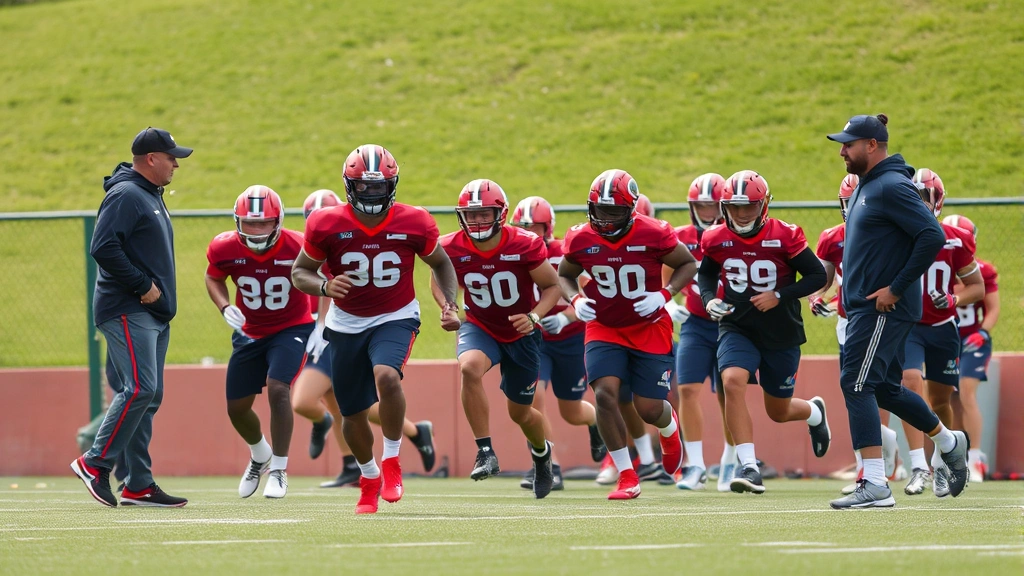
” alt=”Team of football players running conditioning drills on practice field with coach”/>
Monitoring Progress and Adjusting Your Program
Data-driven training separates elite programs from mediocre ones. Monitoring specific metrics allows you to objectively assess progress and make intelligent adjustments.
Repeated-Sprint Ability (RSA) is the primary metric for football stamina. Perform 6 maximal 40-yard sprints with 20-second recovery between sprints. Track total time and the percentage decrement from sprint 1 to sprint 6. Elite players show less than 5% decrement; average players show 10-15%. Progressive improvement in this metric directly correlates with improved fourth-quarter performance.
Lactate Threshold Testing provides insight into your aerobic capacity and lactate clearance ability. This requires a sports science facility with metabolic testing capability, but many universities and sports medicine clinics offer this service. Knowing your exact lactate threshold allows you to precisely calibrate training intensities.
Heart Rate Variability (HRV) monitoring provides daily insight into recovery status. Higher HRV indicates better parasympathetic activation and recovery. Lower HRV suggests inadequate recovery. Using a simple HRV app (Whoop, Oura, Elite HRV), you can adjust daily training intensity based on recovery status. This prevents overtraining and optimizes adaptation.
Perceived Exertion Ratings combined with objective metrics provide comprehensive progress assessment. After conditioning sessions, rate effort on a 1-10 scale. Over time, the same absolute workload should feel progressively easier—indicating improved capacity.
Adjust your program every 4 weeks based on these metrics. If repeated-sprint ability isn’t improving, increase HIIT frequency. If lactate threshold plateaus, incorporate more tempo work. If recovery metrics suggest overtraining, reduce volume by 15-20% for one week. This dynamic approach ensures continuous progress rather than plateaus.
FAQ
How long does it take to significantly improve football stamina?
Measurable improvements typically emerge within 2-3 weeks of consistent training. Significant performance changes require 6-8 weeks of dedicated effort. Elite-level stamina development takes 12-16 weeks of progressive training. Consistency matters more than intensity—steady effort over months beats sporadic high-intensity training.
Can I build stamina during the competitive season?
Yes, but training volume must decrease to allow recovery between games. During season, emphasize maintenance and position-specific conditioning rather than major adaptations. Incorporate 1-2 stamina sessions weekly, reduced from the 3-4 sessions typical of offseason training. This maintains gains while managing fatigue for game performance.
What’s the best time to do stamina training?
Early offseason is optimal because you can tolerate high training volume without competitive demands. As the season approaches, integrate stamina training into your regular practice schedule. During season, perform conditioning earlier in practice when fatigue is minimal, allowing quality efforts. Never do intense conditioning immediately before competition.
Should I do stamina training on the same day as strength training?
Strategic sequencing matters. If combining sessions, perform strength training first while neural capacity is highest, then conditioning afterward. Alternatively, separate them by 6+ hours. Never perform intense conditioning immediately before heavy strength training—this compromises both qualities. Elite programs often use separate conditioning days for optimal adaptation.
How do I know if I’m overtraining?
Watch for persistent fatigue, elevated resting heart rate, decreased performance despite training, sleep disruption, and increased injury risk. Heart rate variability drops significantly during overtraining. If these signs appear, reduce training volume by 20-30% and prioritize recovery for one week. Listen to your body—pushing through overtraining reduces performance and increases injury risk.
What’s the relationship between speed and stamina?
They’re complementary. Speed without stamina means you’re dangerous early but ineffective late. Stamina without speed means you’re still standing when others quit, but you’re not threatening. Elite football bros develop both simultaneously through intelligent training. Speed work (plyometrics, short sprints) maintains explosiveness while stamina training (HIIT, intervals) builds capacity. This combination produces complete performers.
How does stamina training affect muscle mass?
High-volume, low-intensity conditioning can reduce muscle mass—the “cardio kills gains” phenomenon. However, strategic stamina training using HIIT and sport-specific drills preserves muscle mass while building capacity. The key is maintaining adequate protein intake and not performing excessive steady-state cardio. Most elite programs maintain or increase muscle mass while dramatically improving stamina through intelligent programming.
Understanding these principles and implementing them consistently transforms your football performance. The fourth quarter separates champions from contenders. With elite stamina, you finish strong when others fade.


