
NSAA Football Workouts: Expert Coach Recommendations for Peak Performance
The Nebraska School Activities Association (NSAA) football program demands exceptional physical conditioning, explosive power, and mental toughness. Whether you’re a lineman, skill position player, or defensive specialist, the right NSAA football workouts separate elite performers from the rest. High school football coaches across Nebraska have perfected training protocols that develop the speed, strength, and endurance required to dominate on Friday nights. This comprehensive guide reveals proven conditioning strategies, strength-building exercises, and periodized training plans that NSAA coaches recommend for maximum athletic development.
Success in NSAA football isn’t just about talent—it’s about systematic preparation. Players who follow structured workout programs experience 30-40% improvements in vertical jump, 15-20% gains in sprint speed, and significantly reduced injury rates. The most successful NSAA programs implement year-round training cycles that build foundational strength during off-season, develop sport-specific power during pre-season, and maintain peak performance throughout the competitive season. Understanding how to properly periodize your training, execute compound movements with perfect form, and recover strategically will transform your football performance.

Off-Season Strength Training for NSAA Football
Off-season training forms the foundation of NSAA football excellence. This 12-16 week phase, typically running from November through February, focuses on building absolute strength and muscular hypertrophy. NSAA coaches unanimously recommend prioritizing compound movements that engage multiple muscle groups simultaneously, creating functional strength directly applicable to football movements.
The cornerstone lift for any NSAA football program is the back squat. This exercise builds leg strength, hip power, and core stability essential for blocking, tackling, and explosive first steps. Players should perform 4-5 sets of 3-6 repetitions at 85-90% of their one-rep max, with 3-4 minutes rest between sets. Proper form is non-negotiable: maintain an upright torso, descend until thighs reach parallel or below, and drive through the heels explosively.
The deadlift complements squat training by emphasizing posterior chain development. Hamstrings, glutes, and lower back strength are critical for running, jumping, and injury resistance. Perform 3-4 sets of 2-5 repetitions at 80-90% intensity. Focus on maintaining a neutral spine throughout the movement and accelerating the bar through the drive phase.
Bench press and incline bench press develop chest, shoulders, and triceps—crucial for offensive linemen and defensive players engaging in hand combat. Incorporate 3-4 sets of 5-8 repetitions, varying grip widths to hit different muscle angles. Complementary upper body work should include rows, pull-ups, and shoulder presses to maintain balanced development and prevent injury.
NSAA coaches emphasize that off-season training should follow periodized progression. Begin with higher rep ranges (8-12 reps) at moderate loads during weeks 1-3, progress to moderate rep ranges (5-8 reps) at higher loads during weeks 4-10, and peak with lower rep ranges (2-4 reps) at maximum loads during weeks 11-16. This approach builds both muscle mass and maximum strength while managing fatigue and injury risk.
Accessory exercises round out off-season programming. Include leg press, hack squat, leg curl, leg extension, chest fly, lateral raise, bicep curl, and tricep extension. Perform 3 sets of 8-12 repetitions for accessory work, focusing on controlled tempo and mind-muscle connection. Rest 60-90 seconds between sets.
Core training deserves specific attention in NSAA football workouts. Anti-rotation exercises like Pallof press and landmine rotations, anti-extension movements like ab wheel rollouts and decline sit-ups, and anti-lateral flexion work like side planks and sled drags build the stability necessary for powerful movement and injury prevention. Incorporate core work 3-4 times weekly with 2-3 sets of 8-15 repetitions.
Pre-Season Power Development Programs
The 6-8 week pre-season phase (typically March-April for NSAA programs) transitions strength into explosive power. This period emphasizes Olympic lifts, plyometrics, and sport-specific movements while maintaining strength gains from off-season training. The goal is converting raw strength into football-applicable power and speed.
Power clean and power snatch variations dominate pre-season programming. These movements develop triple extension (ankle, knee, hip extension) explosively—the biomechanical foundation of vertical jump, broad jump, and acceleration. Perform 5-6 sets of 2-3 repetitions at 75-85% intensity, allowing full recovery between attempts. Perfect technical execution is essential; consider hiring a certified strength coach to teach proper form.
Plyometric training amplifies power development. Box jumps, broad jumps, bounding, and depth jumps train the nervous system to recruit muscle fibers explosively. Perform plyometrics early in workouts when the central nervous system is fresh. Execute 3-5 sets of 3-5 repetitions with 2-3 minutes recovery between sets. Quality supersedes quantity; fatigue-induced poor form increases injury risk without providing training benefit.
Med ball training develops rotational power and core explosiveness. Overhead slams, chest passes, rotational throws, and scoop tosses build the explosive power needed for throwing, tackling, and lateral movements. Incorporate 3-4 sets of 6-8 repetitions with 90 seconds rest. Use medicine balls weighing 8-14 pounds depending on player size and experience level.
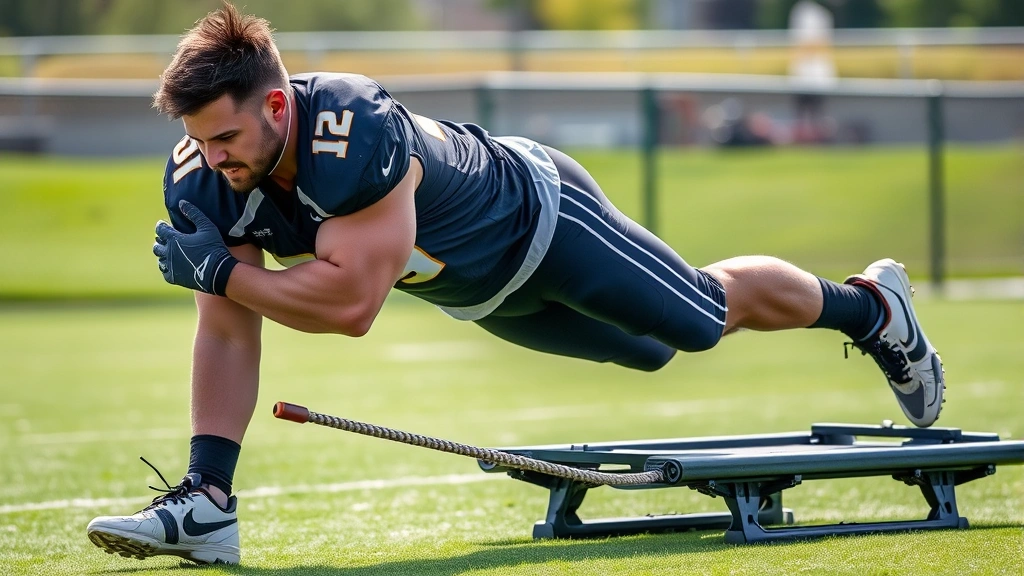
Sled work and resisted sprinting build acceleration and starting strength. Pushing or pulling a weighted sled against resistance forces greater muscle recruitment and power production. Perform 4-5 sets of 20-40 yard distances with heavy resistance (75-150% body weight), allowing full recovery between efforts. This training specifically improves the explosive first step critical in football.
During pre-season, reduce strength training volume slightly while maintaining intensity. Perform main lifts once weekly at competition-level intensity (2-3 sets of 2-3 reps at 85-90%) to preserve strength while emphasizing power development. This strategic deloading prevents overtraining while transitioning toward competitive readiness.
In-Season Maintenance Workouts
Once the NSAA football season begins, training priorities shift toward maintaining strength and power while managing fatigue from games and practices. In-season workouts should be brief, intense, and strategically timed to enhance performance without compromising recovery.
Most NSAA coaches recommend 2-3 strength sessions weekly during the season, performed on non-game days or early in practice days. Each session should last 30-45 minutes, focusing on compound movements at moderate volume. Perform 2-3 sets of 3-5 repetitions on main lifts at 80-85% intensity, maintaining the strength base without excessive fatigue accumulation.
A sample in-season workout might include: Back squat (3 sets x 3 reps), bench press (3 sets x 3 reps), bent-over row (3 sets x 5 reps), and 1-2 accessory exercises (2 sets x 8-10 reps each). This provides sufficient stimulus to maintain strength while limiting volume that interferes with game preparation and recovery.
Plyometric and speed work should reduce in frequency and volume during the season. One dedicated power session weekly, featuring 2-3 plyometric exercises or sled sprints, maintains explosiveness without excessive fatigue. Many NSAA coaches integrate power development into practice structure rather than separate training sessions.
Recovery becomes paramount during the season. Prioritize sleep (8-10 hours nightly), nutrition (adequate protein and carbohydrates), and active recovery (light stretching, foam rolling, walking). Monitor how players feel; if fatigue indicators increase, reduce training volume further. The goal is maintaining performance, not building fitness during the competitive season.
Position-Specific Training Protocols
While all NSAA football players benefit from general strength and power development, position-specific training optimizes performance for individual roles. Understanding these distinctions allows coaches to tailor programming for maximum effectiveness.
Offensive and Defensive Linemen should emphasize lower body and core strength above all. Squats, deadlifts, and leg press should form the foundation, with 4-5 sets of 3-6 repetitions at high intensity. Upper body work focuses on bench press and rows for explosive power in hand combat. Sled work and farmer’s carries build the functional strength needed for sustained blocking and tackling. These players benefit from slightly higher training volume due to their positional demands.
Linebackers require balanced strength with emphasis on explosive power and lateral agility. Include squats and deadlifts alongside Olympic lift variations and plyometrics. Add lateral movements like lateral lunges, lateral sled drags, and lateral bounds to develop the lateral explosiveness needed for sideline-to-sideline pursuit. Core anti-rotation work proves especially valuable for tackling power.
Defensive Backs and Wide Receivers prioritize speed, agility, and explosive lateral power over maximum strength. While maintaining foundational strength (squats, deadlifts, bench press at moderate volume), emphasize plyometrics, sled sprints, and agility ladder work. Single-leg exercises like Bulgarian split squats and single-leg deadlifts develop unilateral strength and ankle stability critical for change-of-direction movements. Incorporate extensive speed work through resistance running and acceleration drills.
Quarterbacks require core stability, rotational power, and lower body strength to generate throwing velocity and withstand contact. Include Olympic lifts and plyometrics for explosive power, but emphasize rotational medicine ball work and anti-rotation core exercises. Maintain adequate lower body strength through squats and deadlifts, but prioritize single-leg stability work for balance and injury prevention.
For comprehensive understanding of how football positions function and develop, review Notre Dame football depth chart resources and Peak Play Arena Blog for additional position-specific insights.
Speed and Agility Development
Speed and agility represent critical components of NSAA football success, yet many programs neglect dedicated speed training. Incorporating systematic speed development alongside strength training produces transformative results.
Acceleration development focuses on the first 10 yards—the most critical distance in football. Perform 4-6 sets of 10-yard sprints with full recovery (3-4 minutes between efforts). Emphasize explosive starts with proper body lean and powerful leg drive. Resisted acceleration work using parachutes, weighted vests, or sled drags forces greater power production and transfers to unresisted sprinting.
Maximum velocity work develops top-end speed through 20-40 yard sprints. Perform 4-5 sets of these distances once weekly with complete recovery. This work should follow strength training, as fatigue impairs sprint quality. Proper sprint mechanics—high knee lift, powerful hip extension, relaxed upper body—ensure optimal results.
Agility training develops change-of-direction ability through cone drills and reactive movements. The T-drill, L-drill, pro shuttle, and 3-cone drill improve cutting ability and deceleration mechanics. Perform these 1-2 times weekly with full recovery between efforts. Emphasize proper foot placement, low center of gravity during cuts, and explosive push-off to change direction efficiently.
Lateral quickness work develops the side-to-side speed essential for defensive backs and receivers. Lateral bounds, lateral shuffles with resistance, and lateral cone drills improve lateral explosiveness. Perform 3-4 sets of 15-20 yard distances with 90 seconds recovery.
Sport-specific conditioning integrates speed work with football movements. Hill sprints build power and mental toughness while reducing impact stress. Tempo runs at 70-80% maximum effort improve lactate threshold and work capacity. Implement conditioning circuits combining sprint work with agility drills and plyometrics to develop football-specific conditioning.
Research from the American College of Sports Medicine demonstrates that athletes who perform dedicated speed training 2-3 times weekly improve sprint times by 5-8% within 8-12 weeks. For NSAA football players, these improvements directly translate to competitive advantage.
Recovery and Injury Prevention
Elite NSAA football programs recognize that training stimulus triggers adaptation only when combined with adequate recovery. Strategic recovery practices separate champions from contenders while protecting player health.
Sleep represents the most powerful recovery modality. During sleep, growth hormone peaks, muscle protein synthesis occurs, and the nervous system consolidates motor learning. NSAA players should target 8-10 hours nightly, maintaining consistent sleep schedules even during demanding seasons. Implement sleep hygiene practices: dark rooms, cool temperatures (65-68°F), and screens off one hour before bed.
Nutrition fuels recovery and adaptation. Players should consume adequate protein (0.7-1 gram per pound body weight daily) distributed across 4-5 meals to maximize muscle protein synthesis. Carbohydrates replenish glycogen stores depleted during training; consume 4-7 grams per kilogram body weight daily depending on training intensity. Healthy fats support hormone production and reduce inflammation. Proper hydration (half body weight in ounces daily, plus losses from sweat) maintains performance and recovery capacity.
Active recovery on non-training days enhances blood flow and reduces soreness without accumulating fatigue. Light walking, swimming, or cycling at conversational intensity for 20-30 minutes promotes recovery while maintaining aerobic capacity. Yoga and mobility work improve movement quality and flexibility.
Foam rolling and soft tissue work reduce muscle tension and promote recovery. Perform 1-2 minutes per muscle group on a foam roller 3-4 times weekly. Focus on primary movers: quads, hamstrings, glutes, calves, thoracic spine, and lats. This practice reduces delayed-onset muscle soreness (DOMS) and improves mobility.
Stretching protocols should emphasize dynamic stretching before training (leg swings, walking lunges, inchworms) and static stretching post-training (30-second holds, 2-3 repetitions per muscle). This approach improves mobility while preserving strength and power.
Injury prevention hinges on proper movement mechanics and progressive training loads. Never increase training volume more than 10% weekly; this conservative progression prevents overuse injuries. Address movement limitations immediately through targeted mobility and stability work. Single-leg exercises develop unilateral strength and ankle stability. Anti-rotation core work prevents lower back injuries. Posterior chain emphasis (deadlifts, rows, reverse flyes) prevents shoulder injuries from muscular imbalances.
Understand that how long a football game lasts impacts fatigue accumulation and recovery demands. Extended games increase injury risk and recovery time requirements, making in-season training management even more critical.
Work with certified athletic trainers or sports medicine physicians to screen for injury risk. Pre-participation physical exams identify movement limitations, strength imbalances, or structural concerns requiring intervention. Regular movement assessments (Functional Movement Screen, Y-Balance Test) track progress and identify emerging issues.
Periodically deload by reducing training volume 40-50% for one week every 4-6 weeks. This strategic recovery week allows accumulated fatigue to dissipate while maintaining fitness, reducing injury risk and preventing overtraining syndrome.
FAQ
What’s the best NSAA football workout split for off-season training?
A 4-day split works excellently for NSAA players: Day 1 (Lower Body A: Squat focus), Day 2 (Upper Body A: Bench focus), Day 3 (Lower Body B: Deadlift focus), Day 4 (Upper Body B: Row focus). Include accessory work and core training each session. This allows adequate recovery between sessions while providing sufficient training frequency for strength development.
How often should NSAA football players perform speed training?
Incorporate dedicated speed work 2-3 times weekly during off-season and pre-season phases. During the competitive season, reduce to 1-2 sessions weekly. Always perform speed work when fresh (early in workouts or on dedicated days), as fatigue impairs sprint quality and increases injury risk.
Should NSAA players train during the football season?
Yes, absolutely. In-season training maintains strength and power while managing fatigue. Perform 2-3 brief (30-45 minute) sessions weekly on non-game days, focusing on main lifts at moderate volume. This prevents strength loss and maintains competitive edge without interfering with game preparation and recovery.
What’s the optimal protein intake for NSAA football players?
Research supports 0.7-1.0 grams of protein per pound of body weight daily for athletes in strength training. Distribute across 4-5 meals (20-40g per meal) to maximize muscle protein synthesis. Include quality sources: chicken, fish, beef, eggs, Greek yogurt, cottage cheese, and legumes.
How long does it take to see strength improvements from NSAA football workouts?
Most players notice strength improvements within 2-3 weeks as nervous system adaptations enhance force production without significant muscle growth. Noticeable muscle growth typically appears after 4-6 weeks of consistent training. Performance improvements (sprint times, vertical jump) often lag strength gains by 2-4 weeks as the body learns to apply increased strength explosively.
Should NSAA football players use supplements?
Focus first on nutrition fundamentals: adequate protein, carbohydrates, healthy fats, and hydration. Evidence-supported supplements include creatine monohydrate (5g daily), which improves strength and power; whey protein powder for convenient protein intake; and beta-alanine for high-intensity performance. Consult with sports dietitians before using any supplements. Avoid unregulated products that may contain banned substances.
How should NSAA players periodize training across the year?
Structure training in phases: Off-season (November-February) emphasizes absolute strength, Pre-season (March-April) develops power, Competitive season (August-November) maintains fitness while managing fatigue, and brief transition period (rest and recovery). This periodized approach prevents plateaus, manages fatigue, and peaks performance for competition.


