Best Football Throwing Machines? Coach’s Guide to Automated Training Excellence
Football throwing machines have revolutionized how quarterbacks, receivers, and coaches approach skill development. Whether you’re running a high school program, college team, or professional organization, automated throwing systems deliver consistent, repeatable training that manual passing simply cannot match. These machines eliminate variables—arm fatigue, inconsistent release points, and human error—allowing athletes to focus entirely on route running, decision-making, and catching mechanics.
The investment in a quality football throwing machine pays dividends across your entire program. Players get unlimited reps regardless of weather or quarterback availability. Coaches gain data-driven insights into performance metrics. Teams accelerate development timelines and reduce injury risk through controlled progression. This comprehensive guide explores the top machines on the market, key features that matter, and how to integrate automated training into your coaching philosophy.
Why Football Throwing Machines Transform Training Programs
Traditional quarterback training relies heavily on live practice time, creating bottlenecks in development. When only one or two QBs exist on a roster, receivers and defensive backs struggle to get adequate reps. A throwing machine eliminates this constraint entirely. Your entire receiving corps can run routes against consistent, predictable passes while quarterbacks focus on game film and decision-making.
Research from the American College of Sports Medicine emphasizes that skill acquisition requires high-repetition practice with immediate feedback. Throwing machines provide exactly this framework. Athletes can execute 100+ quality reps in a single session without fatigue degrading performance quality. This volume accelerates motor learning and builds muscle memory faster than traditional methods.
The consistency factor cannot be overstated. Every throw from a quality machine arrives at identical velocity, trajectory, and release point. This allows receivers to develop true timing and anticipation. Defensive backs can practice break timing and coverage recognition against predictable stimuli before facing live quarterbacks. Coaches observe measurable improvements in catch rates, route precision, and overall offensive execution.
Beyond skill development, automated throwing systems reduce injury risk. Coaches control velocity progression, ensuring young athletes don’t face excessive velocity before their bodies adapt. Consistent mechanics reduce the stress injuries that plague quarterbacks throwing hundreds of repetitions daily. The machine never experiences arm fatigue or compensatory movement patterns that lead to shoulder and elbow injuries.
Top Football Throwing Machines Ranked by Performance
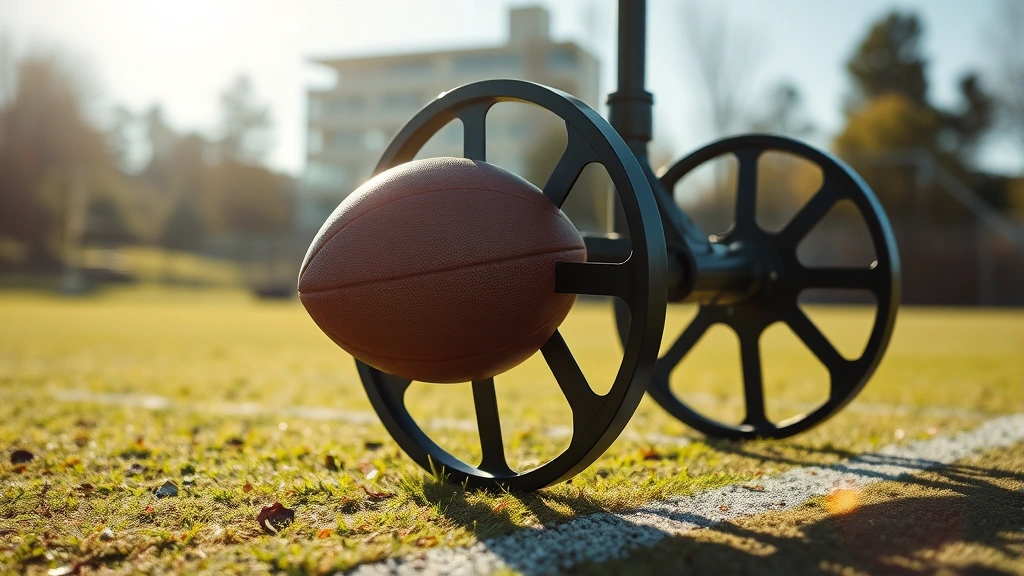
JUGS M2 Passing Machine leads the market with unmatched reliability and professional adoption. NFL teams, college programs, and high schools standardize on JUGS equipment. The M2 achieves 80+ MPH velocity with exceptional accuracy. Dual-wheel technology ensures consistent spiral and placement. Coaches adjust distance, angle, and velocity through intuitive controls. The machine handles 7-step to 3-step routes seamlessly. Investment ranges $4,000-$5,500 depending on accessories.
Trend Sports Heater 3000 offers an excellent mid-range alternative. This machine delivers consistent velocity up to 75 MPH with reliable accuracy within two feet. The Heater 3000 excels at receiver-focused training with adjustable launch angles. Portability makes it ideal for programs with space constraints. Price point sits around $2,800-$3,500, making it accessible for developing programs.
JUGS Small Field Passing Machine specializes in short-range training. Perfect for slot receivers, tight ends, and underneath routes, this system delivers precision within 10-25 yards. The compact footprint fits any facility. Coaches use this alongside longer-range machines for comprehensive training. Cost ranges $2,200-$3,000.
Atec Sports MVP-2 brings advanced technology with programmable sequences. This machine learns from your playbook, delivering different routes in sequence. Athletes practice reading progressions and adjusting timing. The MVP-2 costs $5,500-$7,000 but delivers exceptional value for elite programs.
First Pitch Heater serves baseball-first programs needing occasional football training. While not purpose-built for football, the Heater delivers acceptable velocity and consistency for basic receiver drills. Budget option at $1,500-$2,000, though limited football-specific functionality.
Essential Features Every Coach Should Evaluate
Velocity Range and Accuracy determine which athletes and situations the machine serves. Most quality machines hit 50-80+ MPH with accuracy within 12-18 inches. Verify specifications match your program’s needs. High school programs may prioritize 60-75 MPH ranges, while college and professional teams need 75+ MPH capability. Accuracy of ±6 inches represents professional-grade performance.
Understand how velocity affects ball flight. Higher velocities produce different spirals and trajectories than NFL quarterback throws. Machines that adjust spin rate alongside velocity deliver more realistic ball flight. Check whether the machine maintains accuracy at all velocity settings—some systems degrade at extreme ranges.
Launch Angle Adjustability enables training across your entire field. Machines should adjust vertically from 0-45 degrees minimum. Horizontal adjustment allows sideline routes, crossing patterns, and various receiver splits. Premium systems offer 360-degree positioning. Verify adjustment mechanisms are smooth and hold position during operation.
Distance Capability ranges from 10 yards to 80+ yards depending on the system. Football passing tree routes demand different distances. Your machine should cover 5-65 yards minimum to handle most offensive concepts. Verify the machine maintains accuracy at maximum distance—performance often degrades beyond 60 yards.
Portability and Setup impact daily usability. Machines weighing 200+ pounds require permanent installation. Lighter systems ($150-300 pounds) move between practice fields. Consider storage requirements and whether your facility supports permanent installation. Setup time should be under 15 minutes for daily use.
Ball Feeding Systems dramatically affect training efficiency. Single-ball operation requires manual reloading between throws. Dual-ball systems reduce downtime. Premium machines feature automatic ball hoppers holding 20+ balls. Coaches should evaluate whether feeding mechanisms jam or misfire—reliability matters more than capacity.
Safety Features protect athletes and coaches. Machines should have emergency stop buttons, protective caging, and clear operational zones. Verify the system won’t operate if someone enters the throwing lane. Check whether balls can dislodge during operation and create hazards.
Integration Strategies for Maximum Training Impact
Successful implementation requires strategic planning. Start by building team training culture around the machine. Introduce it during winter conditioning when players expect new training stimuli. Use the machine for position-group work before full-team practice, preventing disruption to existing routines.
Design specific drill progressions that leverage machine consistency. Start with stationary catch drills at close range (5-10 yards). Progress to break-on-the-ball routes. Add defensive recognition drills where DBs read receiver splits and machine timing. Finally, integrate game-realistic scenarios with multiple receivers running concurrent routes.
Implement data collection protocols. Record catch rates, drop percentages, and timing metrics. Track which route concepts produce highest success rates. Use this data to refine your offensive play selection and identify receiver development priorities. Video analysis alongside machine training accelerates improvement.
Establish machine-based assessment protocols. Use consistent velocity and placement to evaluate receiver skill levels. Measure improvement through catch rate progression over weeks and months. Compare performance across different route types and distances. This objective data guides position battles and playing time decisions.
Rotate athletes systematically. Assign specific time blocks for different position groups and individual development. Receivers get dedicated machine reps. Defensive backs practice coverage recognition. Individual position coaches use the machine for specialized skill work. Avoid monopolization by any single group.
Complement machine training with live quarterback work. The machine teaches consistency and timing, but live reps develop communication and adaptive skills. Aim for 60% machine reps and 40% live quarterback reps during the offseason. During season, reverse the ratio to maintain game-readiness.
Comparing Price Points and Value Propositions
Budget-conscious programs should consider total cost of ownership. Initial purchase price represents only the beginning. Factor in delivery and setup ($500-$1,500), maintenance supplies ($200-$400 annually), potential repairs ($300-$1,000 per incident), and space requirements. A $2,500 machine might cost $4,000+ when fully implemented.
Professional-grade machines ($5,000-$7,000) cost more upfront but deliver superior reliability and longevity. These systems last 10+ years with minimal repairs. Budget-grade machines ($1,500-$2,500) may require replacement within 5-7 years. Calculate cost-per-year to compare true value. A $5,500 machine lasting 12 years costs $458 annually versus a $2,000 machine lasting 5 years at $400 annually—similar cost but vastly different capability.
Mid-range options ($3,000-$4,000) offer excellent compromise. JUGS M2 and Trend Sports Heater 3000 deliver professional-grade reliability at accessible prices. Most college programs and elite high schools operate successfully at this investment level. The extra $1,500-$2,000 over budget machines provides substantial reliability improvements.
Consider financing options. Many equipment suppliers offer payment plans spreading costs over 12-24 months. This approach preserves operating budgets while enabling immediate implementation. Some programs use booster club funding or donor contributions to offset capital expenses.
Evaluate warranty coverage. Professional machines typically include 2-3 year warranties covering parts and labor. Budget machines often provide 1-year limited warranties. Extended warranties ($500-$1,000) provide peace of mind but represent additional cost. Verify what’s covered—some warranties exclude normal wear items.
Maintenance and Longevity Considerations
Proper maintenance extends equipment life significantly. Schedule monthly inspections checking for loose bolts, wheel alignment, and motor performance. Clean the machine after every 20 hours of operation—dust accumulation degrades accuracy. Lubricate moving parts quarterly using manufacturer-specified products.
Ball condition dramatically impacts performance. Worn balls with compromised seams throw inconsistently. Replace balls annually or after 5,000+ throws. Store balls properly in climate-controlled facilities—extreme temperature variations degrade leather and rubber. Damaged or waterlogged balls must be removed immediately.
Monitor wheel wear patterns. Uneven wear indicates misalignment or imbalanced wheels. Have wheels professionally balanced annually. Replace wheels when wear exceeds 20% of original diameter—typically every 3-4 years depending on usage volume.
Protect the machine from weather. Outdoor installations require weatherproof covers during storage. Moisture exposure corrodes electrical components and degrades wheel performance. If possible, store the machine indoors or under protective structures between seasons.
Document all maintenance activities. Keep records of inspections, repairs, and replacements. This documentation supports warranty claims and helps predict future maintenance needs. Establish preventative maintenance schedules aligned with your practice calendar.
Train multiple staff members on operation and basic troubleshooting. When only one person understands the machine, equipment downtime becomes critical. Ensure assistant coaches, strength staff, and managers can operate the system and identify common problems.
Budget annually for maintenance and repair. Allocate $500-$1,000 per year for professional machines depending on usage volume. This reserve covers unexpected repairs and replacement parts. Underfunding maintenance leads to equipment failure during critical training periods.
FAQ
What’s the difference between JUGS and Trend Sports machines?
JUGS M2 emphasizes professional-grade reliability and adoption by NFL teams. Trend Sports Heater 3000 prioritizes value and accessibility for developing programs. JUGS excels at 50-80+ yard accuracy; Heater 3000 performs well to 60 yards. Choose JUGS for elite programs; choose Heater 3000 for budget-conscious teams.
Can throwing machines replace live quarterback training?
No. Machines teach consistency and timing but lack adaptability and communication elements. Use machines for 60% of offseason reps and live quarterbacks for 40%. During season, reverse this ratio. The combination develops complete receiver skills.
What velocity should young athletes train against?
High school freshmen should start at 45-55 MPH, progressing to 60-70 MPH by junior year. College athletes train at 70-80+ MPH. Never exceed realistic velocity for the athlete’s development level—excessive velocity causes injury and poor technique development.
How many throws can athletes handle daily?
Receivers can safely handle 150-200 catches daily with proper rest. Space throws across multiple sessions if possible. Monitor for fatigue and injury signs. Quality trumps quantity—100 focused reps beat 300 fatigued reps.
Do throwing machines work for defensive back training?
Absolutely. DBs practice coverage recognition, break timing, and interception techniques against consistent stimuli. Machine training develops fundamental skills before live quarterback reps. Use machines for 50% of DB training.
What’s the best throwing machine for tight ends?
JUGS Small Field Passing Machine specializes in short-range, high-accuracy throws perfect for tight end development. Trend Sports Heater 3000 also excels at underneath routes. Choose systems allowing 0-30 yard ranges with precise placement.
Can I use a throwing machine outdoors year-round?
Yes, but requires weatherproof covers and climate-controlled storage. Extreme temperatures and moisture exposure degrade performance. Cover the machine between sessions and store indoors during off-season. Some programs install permanent outdoor structures protecting machines from elements.
How accurate are throwing machines at maximum distance?
Professional machines maintain ±12-18 inch accuracy to 60 yards. Accuracy degrades beyond 60 yards—expect ±24+ inches at 80 yards. For deep route training, verify machine specifications at your intended distance before purchasing.


