
Towson Football Workouts: Insider Tips for Peak Performance
Towson University’s football program has built a reputation for developing elite athletes who compete at the highest collegiate level. The secret behind their success isn’t just talent—it’s a comprehensive, science-backed approach to strength and conditioning that transforms players into unstoppable forces on the field. Whether you’re a Towson player looking to gain a competitive edge or an aspiring athlete wanting to train like the Tigers, understanding the principles behind their workout philosophy can revolutionize your performance.
The Towson football coaching staff implements periodized training systems that maximize strength gains, explosive power, and injury resilience. These aren’t generic gym routines; they’re strategically designed programs built on exercise physiology principles that elite programs across the nation follow. By examining what makes Towson’s approach effective, you’ll discover how to structure your own training for dramatic results.
Towson’s Strength Foundation Program
The foundation of any elite football program begins with serious strength development. Towson’s strength coaches prioritize compound movements that build functional power applicable to game situations. The program centers on four primary lifts: the squat, bench press, deadlift, and clean. These movements aren’t arbitrary choices—they’re backed by decades of sports science research showing their direct correlation to athletic performance.
Towson athletes typically follow a periodized training cycle that spans 12-16 weeks, divided into distinct phases. The hypertrophy phase (weeks 1-4) focuses on building muscle tissue through moderate weights and higher repetitions (8-12 reps). This creates the muscle foundation necessary for subsequent strength phases. Players perform 3-4 sets per exercise with 60-90 second rest periods, allowing adequate recovery between sets while maintaining metabolic stress.
The strength phase (weeks 5-8) reduces volume but increases intensity dramatically. Towson players lift heavy weights in the 3-6 rep range, focusing on perfect form and maximum force production. This phase builds the neural adaptations necessary for explosive movements. Rest periods extend to 2-3 minutes, allowing the nervous system to fully recover before heavy attempts.
Key exercises in Towson’s strength program include:
- Back squats: 5×3 at 85-90% max effort
- Deadlifts: 5×2 with 3-minute rest intervals
- Bench press variations: Incline, dumbbell, and board press
- Accessory work: Rows, pull-ups, and core stabilization
- Lower body accessories: Leg press, hack squats, and Romanian deadlifts
Recovery between training sessions is non-negotiable. Towson’s program incorporates strategic deload weeks every 4 weeks, where volume and intensity both decrease by 40-50%. This prevents overtraining, allows adaptation to occur, and prepares athletes for the next training block. Many athletes underestimate the importance of deload weeks, but they’re essential for long-term progress and injury prevention.
Explosive Power Development for Football Athletes
Raw strength means nothing if you can’t express it explosively on the football field. Towson’s coaching staff dedicates significant training time to power development through Olympic lifting variations and plyometric exercises. Power is the product of force and velocity—you need both to dominate in football.
The clean and jerk serves as a cornerstone exercise in Towson’s program. This complex movement develops explosive hip extension, rapid ankle plantarflexion, and coordinated upper body pulling. Athletes perform cleans 2-3 times weekly, working in the 3-5 rep range with 2-3 minute rest periods. The explosive nature of the clean trains the fast-twitch muscle fibers critical for football performance.
Plyometric circuits used by Towson athletes include:
- Box jumps: 5 sets x 3 reps with 2-minute rest
- Broad jumps: 5 sets x 2 reps for maximum distance
- Depth jumps: 4 sets x 3 reps from 18-24 inch boxes
- Bounding drills: 4 sets x 40 meters for hip extension power
- Medicine ball throws: Overhead, rotational, and chest variations
- Jump squats: 4 sets x 6 reps with explosive intent
Towson’s strength coaches emphasize explosive intent on every repetition. You can’t develop power through slow, controlled movements. Every jump, throw, and lift must be performed with maximum velocity. This neurological demand is what separates power training from general strength work.
The timing of power training within the weekly schedule matters significantly. Towson places power work early in training sessions when the nervous system is fresh and capable of maximum recruitment. Attempting power exercises when fatigued compromises technique and reduces adaptations. A typical training day might begin with Olympic lift variations, followed by strength work, and conclude with conditioning.

Speed and Agility Training Systems
Football is a game of space and time. The ability to accelerate, decelerate, and change direction separates elite players from average competitors. Towson’s speed and agility program is systematic and progressive, building movement quality before adding complexity.
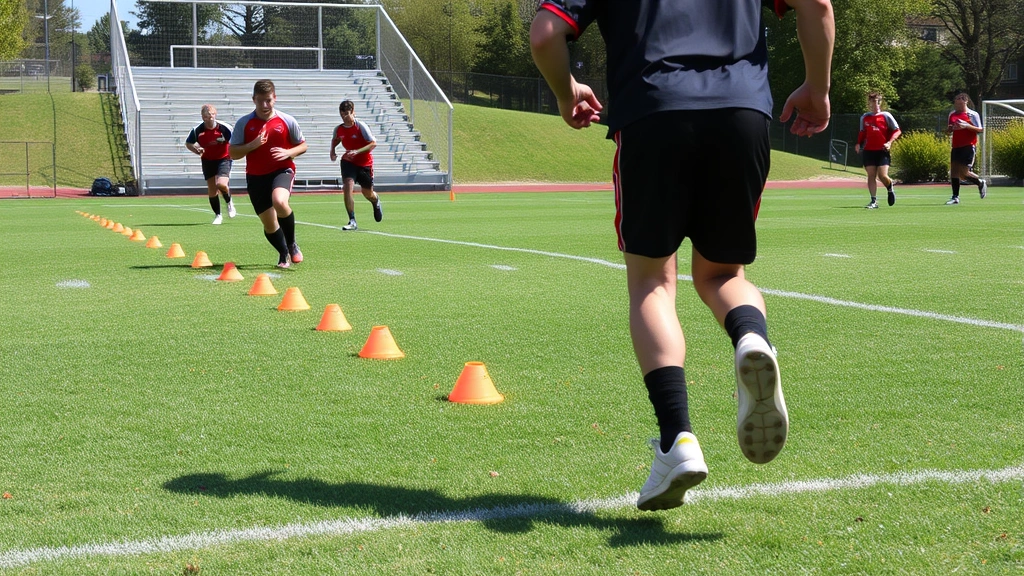
Linear acceleration is the foundation. Towson athletes spend considerable time on 10-yard and 20-yard sprint work, focusing on proper mechanics. The first three steps of a sprint are critical—they determine your ability to create separation from defenders. Coaches emphasize low shin angle, powerful knee drive, and optimal ground contact time during these critical initial steps.
Towson’s agility progression includes:
- Movement preparation: Dynamic stretching and activation drills (10 minutes)
- Mechanics work: Walking lunges, A-skips, B-skips, and high-knee marches
- Linear sprints: 10-yard, 20-yard, and 40-yard dashes (3-4 repetitions with full recovery)
- Change of direction: T-drills, 3-cone drills, and L-shaped shuttle runs
- Reactive agility: Partner-based directional changes and sport-specific cuts
- Deceleration training: Backward sprints and lateral shuffle with controlled stops
Deceleration is often overlooked but absolutely critical. Many injuries occur during deceleration when eccentric muscle forces are highest. Towson incorporates specific deceleration drills that train athletes to absorb force safely. Backward running, lateral shuffles with controlled stops, and cutting drills that emphasize eccentric loading build the muscular resilience necessary for injury prevention.
Agility work requires complete recovery between repetitions. Towson’s coaches use 1:3 or 1:4 work-to-rest ratios during agility sessions, meaning for every 10 seconds of intense work, athletes rest 30-40 seconds. This allows the nervous system to recover fully, ensuring maximum speed on every repetition. Fatigue degrades movement quality and increases injury risk.
Position-Specific Conditioning Protocols
While foundational strength and speed apply to all players, Towson recognizes that different positions have unique demands. Linemen require different conditioning than defensive backs. The program is customized accordingly, with position coaches designing sport-specific protocols.
Offensive and defensive linemen at Towson emphasize lower body power and explosive hip extension. Their training includes high-volume squat and deadlift work, supplemented with heavy sled pushes and pulls. Conditioning focuses on repeated explosive efforts with short recovery periods, mirroring the demands of playing in the trenches.
Linebacker and safety conditioning demands multidirectional movement capacity. Towson’s program incorporates extensive cone drills, shuttle runs, and reactive agility work. These players need exceptional deceleration ability and lateral quickness. Training emphasizes change-of-direction drills performed when partially fatigued, replicating game conditions.
Wide receivers and defensive backs require elite linear speed and directional change ability. Towson’s speed and agility program for these positions includes extensive sprint work, planted-foot cutting drills, and reactive agility challenges. These players also perform upper body strength work to build resilience during contested catches and physical coverage situations.
Quarterbacks have distinct conditioning needs. While they require functional lower body strength, their training emphasizes rotational power for throwing, shoulder stability, and lower body mobility. Towson’s QB-specific program includes medicine ball rotational work, single-leg balance drills, and explosive lower body exercises that generate throwing power.
Implementing position-specific injury prevention strategies ensures athletes stay healthy throughout the season. Each position group receives customized prehab work addressing their specific injury risks.
Recovery and Injury Prevention Strategies
Elite performance isn’t built in the weight room—it’s built during recovery. Towson’s coaching staff understands that adaptation occurs during rest, not during training. The program incorporates sophisticated recovery protocols that maximize adaptation and minimize injury risk.
Sleep is the cornerstone of recovery. Towson athletes are encouraged to prioritize 8-10 hours nightly. During sleep, growth hormone increases, muscle protein synthesis accelerates, and the nervous system consolidates motor learning. Players who sleep adequately show dramatic improvements in strength, speed, and body composition compared to sleep-deprived teammates.
Nutrition timing is critical for recovery. Towson’s sports nutrition team ensures athletes consume protein and carbohydrates within 30-60 minutes post-workout. This window maximizes muscle protein synthesis and replenishes glycogen stores. A typical post-workout meal includes 30-40g protein and 60-80g carbohydrates.
Active recovery modalities employed by Towson include:
- Foam rolling: 5-10 minutes daily targeting major muscle groups
- Dynamic stretching: 10 minutes pre-workout for movement preparation
- Static stretching: 10-15 minutes post-workout for flexibility maintenance
- Contrast water therapy: Alternating hot and cold water immersion
- Massage therapy: Weekly sessions focusing on high-stress areas
- Yoga and mobility work: 2-3 sessions weekly for joint health
- Ice baths: Post-practice on high-intensity training days
Injury prevention is built into every aspect of Towson’s program. Avoiding sports injuries requires proactive strategies, not reactive treatment. The program includes:
- Comprehensive movement screening identifying imbalances
- Corrective exercise programs addressing identified deficiencies
- Proprioceptive training improving joint stability
- Eccentric training building deceleration strength
- Prehab work preventing common football injuries
Medical staff monitor workload carefully. Towson uses GPS tracking during practices to measure high-speed running distance, sprint count, and acceleration events. This objective data prevents overtraining and allows coaches to manage fatigue systematically. When workload spikes, recovery is prioritized accordingly.
Nutrition and Supplementation Guidelines
Training stimulus creates the demand for adaptation, but nutrition provides the building blocks. Towson’s sports nutrition program is comprehensive and science-based, supporting the massive energy and protein demands of elite football athletes.
Macronutrient targets for Towson athletes typically include:
- Protein: 1.6-2.2g per kilogram of body weight daily
- Carbohydrates: 6-10g per kilogram depending on training intensity
- Fat: 1.0-1.5g per kilogram for hormone production
A 200-pound player (91kg) would target approximately 145-200g protein daily, distributed across 4-5 meals. This consistent protein intake maximizes muscle protein synthesis and supports recovery from intense training.
Supplementation at Towson focuses on evidence-based products:
- Creatine monohydrate: 5g daily for strength and power enhancement
- Beta-alanine: 3-5g daily for buffering lactate during high-intensity efforts
- Caffeine: 3-6mg/kg 30-60 minutes pre-workout for performance enhancement
- Carbohydrate-electrolyte beverages: During practice for hydration and energy
- Vitamin D: Especially during winter months when sun exposure decreases
- Omega-3 fatty acids: For inflammation management and joint health
Towson’s approach emphasizes whole foods first. Supplements fill gaps that food alone cannot address, but they’re not substitutes for quality nutrition. Every athlete receives individualized nutrition plans based on their specific goals, training phase, and body composition targets.
Hydration strategy is meticulous. Athletes weigh themselves before and after practice, aiming to lose no more than 2% of body weight. For a 200-pound player, this means limiting fluid loss to 4 pounds. Sweat rate varies by individual, climate, and intensity, so personalized hydration plans are essential.
Game Day Performance Optimization
All training culminates in game day performance. Towson’s coaching staff implements specific protocols to optimize performance when it matters most. The week leading to competition differs significantly from regular training weeks.
Game week structure at Towson typically follows this pattern:
- Monday-Tuesday: Light recovery work, mobility, and technique refinement
- Wednesday: Main strength session with reduced volume (70% of normal)
- Thursday: Short speed work and sport-specific drills
- Friday: Walk-through practice, no heavy lifting
- Saturday (game day): Pre-game warm-up and activation routine
Reduced volume during game week allows nervous system recovery while maintaining movement patterns and confidence. Heavy squats and deadlifts are still performed but with fewer total repetitions. This maintains neuromuscular function without accumulating fatigue.
Pre-game activation routines at Towson include:
- Dynamic warm-up: 15 minutes including movement preparation
- Mobility work: Targeting positions of restriction
- Activation drills: Glute bridges, band walks, and core activation
- Sport-specific movements: Position-specific drills at game speed
- Mental preparation: Visualization and breathing techniques
- Caffeine consumption: 3-6mg/kg 30-60 minutes pre-kickoff
Consistency in pre-game routines is critical. Athletes perform the same activation sequence before every game, creating neural familiarity and confidence. The routine becomes automatic, freeing mental resources for tactical focus.
Understanding college football predictions and competitive expectations helps athletes mentally prepare. Towson’s sports psychology team works with players to develop resilience and maintain focus regardless of external pressure or expectations.
FAQ
How often should Towson football players train per week?
Towson athletes typically train 4-5 days per week in the weight room, with additional speed and agility work 2-3 times weekly. This totals 6-8 training sessions per week. Training frequency allows adequate volume while maintaining recovery between sessions. Off-season programs are more frequent than in-season routines, which prioritize recovery.
What’s the most important exercise for football players?
The back squat is arguably most important because it develops lower body strength, power, and size applicable to all positions. However, comprehensive development requires compound movements including deadlifts, cleans, and presses. No single exercise builds complete football athleticism.
How long does it take to see results from Towson-style training?
Neurological adaptations occur within 2-3 weeks, manifesting as strength improvements without significant muscle growth. Visible muscle growth typically requires 4-6 weeks. Significant performance improvements in speed and power usually require 8-12 weeks of consistent training. Patience and consistency are essential.
Can non-Towson athletes use these training principles?
Absolutely. The principles underlying Towson’s program—progressive overload, periodization, sport-specific training, and recovery emphasis—apply universally. Any serious athlete can implement these strategies for dramatic improvements. Consult qualified strength coaches to customize programs for your specific goals and current fitness level.
What’s the role of the strength coach in Towson’s program?
Strength coaches at Towson design periodized programs, monitor athlete progress, teach proper technique, and manage training load. They work collaboratively with position coaches, sports medicine staff, and nutritionists to optimize athlete development. Regular communication ensures training supports competitive demands.
How does Towson manage fatigue during the season?
In-season training reduces volume significantly while maintaining intensity on compound movements. GPS tracking monitors practice workload, allowing coaches to adjust training accordingly. Recovery modalities increase during season. Game week structure reduces training stress, allowing athletes to arrive fresh on game day.
Towson’s football program represents elite training methodology backed by sports science research and refined through decades of competitive experience. Whether you’re developing as a player or coaching athletes, these principles provide the foundation for transformative results. Consistency, proper progression, and recovery emphasis separate good programs from great ones. Implement these strategies with discipline, and you’ll experience performance improvements that exceed expectations.
For more insights into competitive athletics, explore Peak Play Arena’s comprehensive blog covering all aspects of sports performance. Check high school football scores to track emerging talent, and stay informed with college football predictions analyzing competitive matchups. Those interested in broader sports topics can explore best sports video games and sports betting odds explained for comprehensive sports coverage.


