
Football and Fitness: How They Intersect? Expert Insights
Football stands as one of the most physically demanding sports on the planet, requiring athletes to possess a unique combination of strength, speed, agility, and cardiovascular endurance. Whether you’re a professional player, weekend warrior, or fitness enthusiast looking to understand the sport better, the intersection of football and fitness reveals fascinating insights into human performance optimization. The beautiful game demands far more than technical skill—it demands a body finely tuned through strategic training, proper nutrition, and intelligent recovery protocols.
The modern football player is essentially a finely calibrated athletic machine. Top-level athletes undergo rigorous conditioning programs that would humble most casual gym-goers. From elite European clubs to high school programs, the emphasis on fitness has never been greater. Understanding how football players build and maintain their exceptional physical capabilities can revolutionize your own fitness journey, regardless of your athletic aspirations. Let’s explore the science, strategies, and expert insights that make football the ultimate full-body fitness test.

The Physical Demands of Modern Football
Professional football matches demand extraordinary physical output. A typical match sees outfield players covering 10-13 kilometers, with some elite athletes exceeding 14 kilometers per game. But distance alone doesn’t capture the intensity. Players engage in explosive sprints, rapid directional changes, and sustained efforts under fatigue—all while maintaining technical precision with the ball. This multifaceted physical requirement makes football a comprehensive test of athletic capability.
The sport requires simultaneous development of multiple fitness components: aerobic capacity for sustained play, anaerobic power for explosive movements, muscular strength for physical contests, and agility for quick directional changes. Research from the American College of Sports Medicine confirms that elite football players demonstrate exceptional performance across all major fitness metrics. The modern game has evolved significantly, with data analytics revealing that high-intensity efforts have increased by 50% over the past decade compared to matches from the early 2000s.
Understanding these demands helps explain why professional clubs invest millions in sports science departments. Every player’s training is monitored through GPS technology, heart rate monitoring, and performance analytics. The Peak Play Arena Blog regularly explores how elite teams structure their programs to maximize these physical attributes.
Cardiovascular Conditioning: The Foundation
Exceptional cardiovascular fitness forms the bedrock of football performance. Without aerobic capacity, even the most technically gifted player cannot sustain performance throughout a 90-minute match. Football’s cardiovascular demands are particularly challenging because players don’t maintain steady-state effort—they alternate between walking, jogging, sprinting, and high-intensity efforts repeatedly.
Elite football programs employ several cardiovascular training methodologies. Continuous aerobic training builds base fitness, typically conducted at 60-75% of maximum heart rate for extended periods. Interval training, however, more closely mimics match demands. High-intensity interval training (HIIT) protocols involve repeated efforts at 90%+ maximum heart rate with recovery periods, developing both aerobic and anaerobic systems simultaneously. Research published in the Journal of Sports Sciences demonstrates that interval training produces superior adaptations for football-specific fitness compared to traditional steady-state cardio.
The most effective football conditioning combines multiple approaches. A player might perform continuous aerobic work twice weekly, interval sessions twice weekly, and sport-specific conditioning (small-sided games) twice weekly. This varied approach prevents adaptation plateaus and maintains engagement. Players who want to avoid sports injuries must build cardiovascular fitness progressively, as sudden increases in training volume significantly increase injury risk.
Strength Training for Football Excellence
Modern football demands significant strength development, though many assume the sport requires only endurance. Contemporary analysis reveals that elite players generate exceptional power outputs during sprints, jumps, and physical contests. Strength training for football differs fundamentally from bodybuilding or pure powerlifting—the goal is functional strength that transfers directly to match performance.
Lower body strength development takes priority in football conditioning. Squats, deadlifts, and lunges build the quadriceps, hamstrings, and glutes necessary for explosive acceleration and deceleration. Single-leg exercises prove particularly valuable, as football involves asymmetrical movements—sprinting, cutting, and shooting all occur on a single leg. Bulgarian split squats, single-leg Romanian deadlifts, and step-ups develop unilateral strength that prevents imbalances and injuries.
Core strength receives tremendous emphasis in elite programs. A strong core stabilizes the spine during rapid movements, improves balance during physical contests, and transfers force from lower to upper body during shooting and passing. Planks, dead bugs, Pallof presses, and rotational exercises feature prominently. Upper body strength, while less emphasized than lower body work, remains important for shielding the ball, winning aerial contests, and maintaining balance during challenging situations.
Plyometric training—explosive exercises like box jumps, bounding, and medicine ball throws—develops power by training muscles to generate maximum force quickly. This directly translates to football’s explosive demands. Research from sports science journals confirms that plyometric training significantly improves sprint time and vertical jump height in football players. Proper progression and technique are essential, as plyometrics carry injury risk if performed incorrectly or with inadequate preparation.
Agility and Speed Development
Speed separates elite players from competent ones in modern football. The ability to accelerate quickly, reach top speed efficiently, and change direction explosively while maintaining control separates world-class athletes from the rest. Interestingly, football speed differs from pure sprinting speed—players rarely run in straight lines at maximum velocity. Instead, they need acceleration ability and multidirectional speed.
Acceleration development focuses on the first 5-10 meters. Proper sprint mechanics—powerful knee drive, appropriate body lean, and ground contact force—determine acceleration capacity. Coaches use various drills: sled pushes to build force production, resisted sprints using parachutes or bands, and technical drills emphasizing proper mechanics. Players who master acceleration gain tremendous advantage in football’s explosive moments.
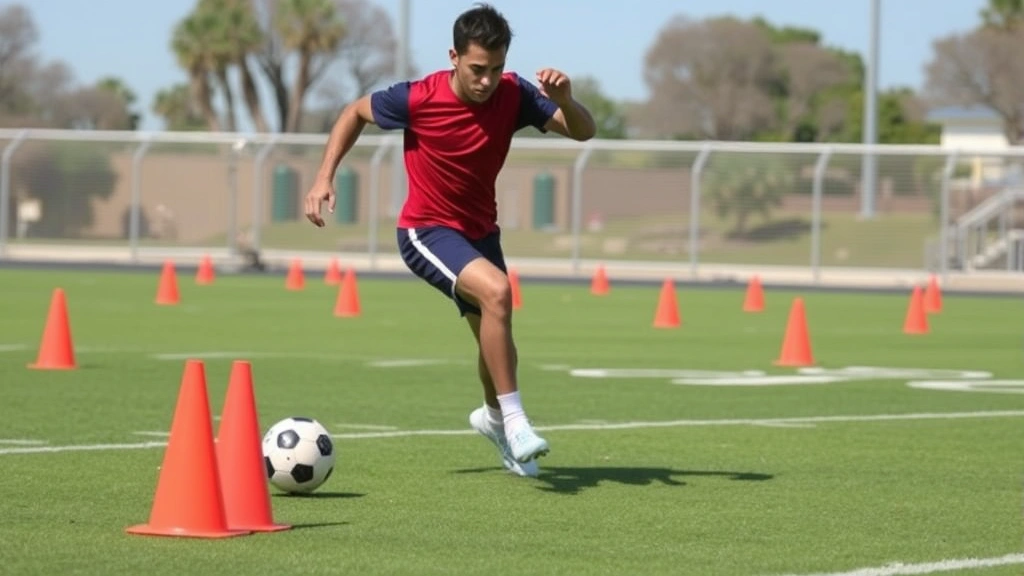
Agility training teaches players to change direction quickly while maintaining balance and control. Traditional cone drills develop agility, but modern programs incorporate sport-specific variations. T-drills, zigzag runs, and reactive drills where players respond to coach signals or ball movement better replicate match demands. The difference between generic agility training and football-specific agility training significantly impacts transfer to actual performance.
Cognitive factors influence agility expression. A player must perceive threats, make decisions, and execute movements—all while fatigued and under pressure. Elite programs incorporate decision-making elements into agility drills, developing the neural pathways that support quick, accurate reactions during matches. This cognitive-motor integration separates training that improves test performance from training that improves match performance.
Injury Prevention and Recovery
Injury prevention represents a critical fitness component often overlooked by recreational athletes. Professional clubs structure entire departments around injury prevention, recognizing that an injured player cannot perform regardless of fitness level. The most common football injuries—hamstring strains, anterior cruciate ligament (ACL) tears, and ankle sprains—often result from inadequate preparation or recovery.
Eccentric strength training, where muscles lengthen under tension, proves particularly effective for injury prevention. Hamstring injuries frequently result from inadequate eccentric strength; players cannot decelerate properly during rapid movements. Nordic hamstring curls—where a partner provides resistance as the athlete lowers themselves—build eccentric hamstring strength that directly reduces injury risk. Research demonstrates that players performing regular eccentric training experience 50% fewer hamstring injuries.
Mobility and flexibility work prevents injuries while maintaining movement quality. Dynamic stretching before activity and static stretching after activity improve range of motion and tissue quality. Foam rolling, though not a substitute for proper training, helps manage muscle tension and fascial restrictions. Many injuries result from movement compensations caused by mobility restrictions—addressing these restrictions prevents problems before they develop.
Recovery receives equal emphasis to training in elite programs. Sleep, nutrition, stress management, and active recovery days all influence injury risk. Players who sleep adequately, maintain proper nutrition, and manage training stress recover faster and remain healthier. The relationship between fatigue and injury is well-established—fatigued athletes make poor decisions, demonstrate degraded movement patterns, and suffer injuries at higher rates.
Those interested in comprehensive injury prevention should review our guide on how to avoid sports injuries for detailed strategies applicable to any sport or fitness activity.
Nutrition for Peak Performance
Nutrition represents the final pillar of football fitness, equally important as training and recovery. Elite players consume carefully planned diets providing appropriate macronutrient ratios, micronutrient density, and hydration status. The demands of modern football—high-intensity efforts, frequent matches, and short recovery periods—make nutritional optimization essential.
Carbohydrate intake requires particular attention. Football’s repeated high-intensity efforts deplete muscle glycogen—the primary fuel for explosive movements. Players consume adequate carbohydrates to maintain glycogen stores between matches and training sessions. Timing matters significantly; consuming carbohydrates before activity ensures adequate fuel availability, while post-activity carbohydrate intake replenishes depleted stores and supports recovery.
Protein intake supports muscle repair and adaptation to training stress. Elite players consume 1.6-2.0 grams of protein per kilogram of body weight daily, distributed across multiple meals and snacks. This intake supports the muscle protein synthesis necessary for strength development and recovery. Timing protein consumption around training sessions optimizes muscle adaptation.
Micronutrient status influences recovery and performance. Iron supports oxygen transport, magnesium supports energy production and muscle function, and various antioxidants support recovery from intense training. Elite programs include nutritionists who analyze blood work and adjust micronutrient intake accordingly. Most recreational players benefit from ensuring adequate fruit and vegetable intake rather than supplementing with isolated nutrients.
Hydration status profoundly impacts performance. Even modest dehydration—2% of body weight—impairs cognitive function, reduces power output, and increases injury risk. Players hydrate before, during, and after matches and training sessions, with intake tailored to sweat rate and environmental conditions. Monitoring urine color provides a simple hydration assessment tool.
Mental Fitness and Performance Psychology
Often overlooked, mental fitness represents a crucial component of football excellence. The sport’s technical demands, pressure situations, and need for rapid decision-making under fatigue all require psychological resilience. Elite players develop mental skills through deliberate practice and psychological training, just as they develop physical skills.
Stress management techniques help players maintain performance under pressure. Breathing exercises, visualization, and mindfulness practices reduce anxiety and improve focus. Research demonstrates that athletes who employ these techniques demonstrate superior decision-making and execution during high-pressure moments. The ability to remain calm during crucial moments separates elite performers from competent athletes.
Motivation and goal-setting drive long-term development. Players who establish specific, measurable, achievable, relevant, and time-bound (SMART) goals demonstrate superior progress compared to those without clear objectives. Intrinsic motivation—driven by personal satisfaction rather than external rewards—predicts long-term commitment and performance. Elite programs emphasize developing intrinsic motivation through meaningful challenges and skill development.
Team cohesion and communication influence both performance and injury risk. Teams with strong communication patterns demonstrate superior tactical execution and fewer injuries. Psychological safety—where players feel comfortable taking risks and making mistakes—fosters the innovation and adaptability that separates elite teams from average ones.
The intersection of football and fitness extends beyond physical preparation into psychological development. Understanding this holistic approach explains why some athletes outperform others despite similar physical attributes—the complete athlete develops all components systematically.


