
College Football Workouts: Athlete Insights for Peak Performance
College football demands an extraordinary level of physical conditioning, mental toughness, and strategic athleticism. Whether you’re a student-athlete preparing for recruitment or a fitness enthusiast inspired by collegiate-level training, understanding the rigorous workout protocols that shape elite football players is transformative. The training regimens employed by Division I programs have evolved dramatically, integrating sports science, advanced recovery techniques, and periodized strength development to maximize performance on game day.
The journey from high school football to college-level competition represents a quantum leap in intensity, complexity, and specialization. Players face unprecedented demands: explosive power development, sport-specific conditioning, injury prevention strategies, and the mental fortitude required to compete at the highest amateur level. This comprehensive guide explores the workout methodologies, training philosophy, and performance insights that define modern college football athlete development.
Strength Training Fundamentals for Football Athletes
College football strength programs prioritize functional, multi-planar movement patterns that translate directly to on-field performance. Unlike bodybuilding-focused training, collegiate programs emphasize relative strength—how much force an athlete can generate relative to body weight—which directly correlates with speed, explosiveness, and injury resilience.
The foundational movements in college football strength training include compound lifts: squats, deadlifts, bench press variations, and Olympic lifting derivatives. These movements activate multiple muscle groups simultaneously, building integrated strength patterns that support the dynamic nature of football. According to American College of Sports Medicine (ACSM) guidelines, periodized strength training increases athletic performance by 20-30% when properly structured.
Lower Body Development forms the foundation of football athleticism. Back squats and front squats develop quadriceps, glutes, and core stability essential for acceleration, deceleration, and change-of-direction movements. Programs typically employ 4-8 week strength phases with rep ranges of 3-6 reps at 85-95% of one-repetition maximum, followed by power development phases using explosive movements like jump squats and box jumps.
Upper Body and Core Integration cannot be overlooked. Bench press variations, rowing movements, and rotational exercises prepare the upper body for contact demands while maintaining structural balance. College programs integrate anti-rotation work—pallof presses, landmine rotations, and dead bugs—to stabilize the spine during explosive, multi-directional movements inherent to football.
The Peak Play Arena Blog offers comprehensive insights into athletic training methodologies that complement strength development. Progressive overload remains paramount: athletes increase weight, volume, or intensity across training cycles to continuously adapt and improve.

Sport-Specific Conditioning Protocols
Football conditioning transcends traditional steady-state cardio. College programs employ metabolic conditioning that mirrors the sport’s demands: high-intensity efforts followed by incomplete recovery, mimicking the stop-start nature of football.
High-Intensity Interval Training (HIIT) dominates conditioning work. Athletes perform 20-40 yard sprints with 30-45 second recovery windows, replicating game scenarios where players execute maximum-effort plays followed by brief rest periods. Research from the National Strength and Conditioning Association demonstrates that sport-specific interval training improves football performance metrics by 15-25% compared to traditional cardio.
Tempo and Threshold Work builds aerobic capacity while maintaining power output. Players perform sustained efforts at 80-90% maximum heart rate for 8-15 minutes, enhancing the aerobic base that supports repeated high-intensity efforts throughout 60-minute games. This training type improves lactate clearance, allowing athletes to maintain performance despite accumulating metabolic byproducts.
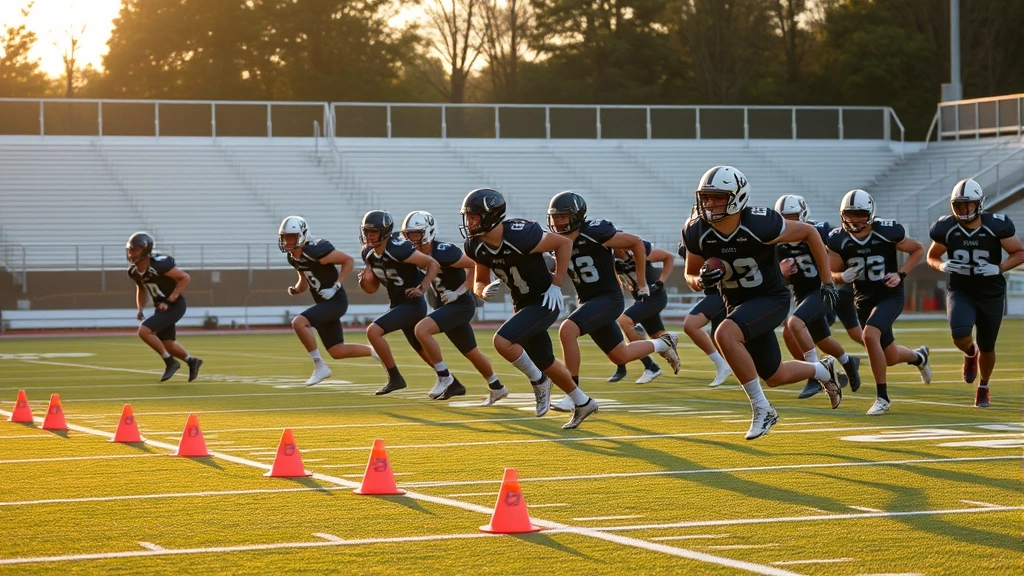
Change-of-Direction Drills develop the neuromuscular qualities essential for football. Cone drills, shuttle runs, and agility ladder work train rapid deceleration, weight transfer, and acceleration in multiple directions. These drills enhance proprioception and joint stability while building the rapid-fire muscle recruitment patterns required for football-specific movements.
Understanding College Football PC resources provides additional context for performance metrics and training evaluation. Conditioning protocols evolve throughout the season: preseason emphasizes building aerobic and anaerobic capacity, in-season training focuses on maintenance and power preservation, and postseason allows recovery and regeneration.
Position-Specific Training Approaches
Elite college football programs recognize that linemen, linebackers, receivers, and defensive backs require distinctly different training emphases. Offensive and Defensive Linemen prioritize absolute strength and power development, with training emphasizing heavy compound movements and explosive drive variations. These positions demand maximum force production over short distances, requiring strength training phases with 1-3 rep maximum efforts.
Linebacker and Safety Development balances strength with lateral agility and cardiovascular demands. These athletes perform more change-of-direction work, lateral bound training, and sustained conditioning efforts. Their training includes single-leg exercises, lateral movement patterns, and explosive vertical jump development to support backfield coverage responsibilities.
Receiver and Defensive Back Training emphasizes speed, agility, and relative power. These positions require maximum velocity development, extensive plyometric work, and lateral movement efficiency. Training incorporates max-velocity sprint work, bounds, and directional change drills performed at near-maximum intensity with complete recovery between efforts.
Quarterback Development combines rotational core strength, shoulder stability, and lower body power. Training focuses on medicine ball rotations, single-leg exercises to develop hip stability, and explosive hip extension to generate throwing velocity. College Fantasy Football analysis often highlights how quarterback training directly impacts on-field performance and statistical output.
Positional specificity extends to recovery strategies: linemen require longer recovery windows due to absolute strength demands, while skill position players benefit from higher training frequency with moderate loads.
Recovery and Injury Prevention Strategies
College football athletes endure exceptional training stress. Sophisticated recovery protocols separate elite programs from mediocre ones. Sleep Optimization ranks as the most important recovery modality—10+ hours nightly supports neural adaptation, hormone optimization, and immune function. Progressive training stress without adequate sleep increases injury risk by 50-60%.
Soft Tissue Management and Mobility Work prevent overuse injuries. Programs implement daily dynamic warm-ups, foam rolling, and targeted mobility work addressing movement restrictions. Addressing hip mobility limitations prevents knee injuries; improving thoracic spine mobility reduces shoulder stress. These interventions require 15-20 minutes daily but dramatically reduce injury incidence.
Nutrition Timing and Hydration Protocols facilitate recovery. Post-workout nutrition within 30-60 minutes optimizes muscle protein synthesis and glycogen repletion. Athletes consume 20-40g protein with 40-80g carbohydrate to accelerate recovery. Hydration strategies account for sweat rate, environmental conditions, and individual physiology to maintain performance and prevent heat illness.
Monitoring Training Load prevents overtraining. Advanced programs track heart rate variability, resting heart rate, and subjective wellness metrics to adjust training intensity. When athletes show elevated resting heart rate or reduced heart rate variability, training stress decreases, allowing recovery. This data-driven approach prevents overtraining syndrome while maximizing adaptation.
Injury Prevention Exercises address football-specific vulnerabilities. ACL injury prevention programs incorporating balance training, eccentric hamstring work, and deceleration training reduce non-contact ACL injuries by 40-70%. Shoulder stability exercises targeting rotator cuff musculature prevent throwing-related injuries in quarterbacks and receivers.
Nutrition and Supplementation for Performance
College football athletes require 4,000-6,000+ daily calories depending on body size, training intensity, and position. Macronutrient Distribution emphasizes adequate protein (1.6-2.2g per kilogram body weight), sufficient carbohydrate for training fuel and recovery (5-10g per kilogram), and healthy fats supporting hormone production and inflammation management.
Periodized Nutrition aligns with training phases. Heavy strength phases require elevated protein and moderate carbohydrate; conditioning phases demand higher carbohydrate intake supporting intense aerobic and anaerobic work. Preseason emphasizes caloric surplus supporting hypertrophy and strength gains; in-season focuses on maintenance and recovery.
Evidence-Based Supplementation provides marginal gains when nutrition fundamentals are established. Creatine monohydrate increases strength and power output by 5-15% with consistent use. Beta-alanine buffers muscle acidity during high-intensity efforts. Caffeine enhances power output, speed, and mental focus. The International Society of Sports Nutrition provides research-backed supplementation guidelines.
Micronutrient sufficiency supports immune function, energy production, and recovery. College athletes often show magnesium, zinc, and iron insufficiency despite adequate caloric intake. Strategic supplementation addresses deficiencies that would otherwise impair performance and recovery.
Game Day Preparation and In-Season Maintenance
Game day preparation begins 72 hours before competition. Taper Protocols reduce training volume while maintaining intensity, allowing neural system recovery while preserving strength and power. Typical in-season training reduces volume by 40-60% while maintaining heavy compound movements and high-intensity intervals at reduced volume.
Pre-Game Warm-Up Protocols prepare the neuromuscular system for maximum performance. Dynamic stretching, activation exercises targeting stabilizer muscles, and sport-specific movement preparation enhance force production and movement efficiency. Research demonstrates that comprehensive warm-ups improve jumping ability by 3-5% and sprinting speed by 1-3%.
In-Season Strength Maintenance preserves training adaptations. College programs perform 2 heavy strength sessions weekly, reducing volume but maintaining intensity. This approach prevents detraining while managing fatigue and injury risk during competitive season. Single-rep and triple-rep maximum efforts maintain neuromuscular recruitment patterns.
Understanding How to Improve Your Golf Swing principles—focusing on movement efficiency and consistency—applies to football training where repetition quality supersedes quantity. Similarly, Sports Betting Odds Explained methodologies reveal how performance metrics directly influence outcomes, highlighting training’s importance.
Post-Game Recovery initiates immediately after competition. Athletes consume high-glycemic carbohydrate and protein within 30 minutes, rehydrate aggressively, and perform light movement to enhance blood flow. Ice baths, contrast water therapy, and compression garments facilitate recovery, though sleep remains the most critical recovery modality.
Explore Top 10 Sports in the World to understand how football’s training demands compare to elite athletic pursuits globally. College football training protocols rival or exceed those of professional athletes in many metrics.
FAQ
What’s the typical weekly training schedule for college football athletes?
College football programs typically structure weekly training with 2-3 heavy strength sessions, 2-3 conditioning sessions, 4-5 practice sessions, and 1-2 recovery days. In-season reduces strength emphasis to 2 sessions weekly while maintaining practice volume. Preseason emphasizes strength and conditioning development with reduced practice complexity.
How much time do college football athletes spend training daily?
Daily training averages 3-4 hours during preseason and in-season. This includes strength training (60-90 minutes), conditioning (30-45 minutes), practice (90-120 minutes), and recovery work (30-45 minutes). Offseason training reduces volume to 90-120 minutes daily, emphasizing strength and power development.
Do college football programs use periodization?
Yes, periodization is fundamental to modern college football training. Programs structure training into macrocycles (year-long), mesocycles (4-12 weeks), and microcycles (weekly). Periodized training increases performance adaptations by 20-30% compared to non-periodized approaches.
What’s the most important injury prevention strategy?
Sleep optimization provides the greatest injury prevention benefit, followed by proper warm-up protocols and mobility work. Athletes sleeping less than 8 hours nightly show 50-60% increased injury risk. Comprehensive warm-ups and daily mobility work reduce specific injury types by 40-70%.
Can recreational athletes use college football training methods?
Absolutely. The fundamental principles—progressive overload, sport-specific conditioning, position-specific emphasis, and comprehensive recovery—apply to all athletic levels. Recreational athletes should scale volume and intensity appropriately while maintaining training structure and recovery priorities.
How important is nutrition for college football performance?
Nutrition is equally important as training stimulus. Inadequate nutrition impairs recovery, reduces strength gains, and increases injury risk. College athletes require 4,000-6,000+ daily calories with strategic macronutrient distribution. Poor nutrition can reduce training adaptations by 30-50%.


