
Best Exercises for Football Players: Expert Insights
Football demands explosive power, lateral agility, cardiovascular endurance, and mental resilience. Whether you’re a high school athlete, college prospect, or professional player, your training regimen determines your on-field performance and longevity. The best football players aren’t just naturally gifted—they’re strategically trained with exercises that mirror game demands and build functional strength where it matters most.
This comprehensive guide reveals the science-backed exercises that elite football programs use to develop unstoppable athletes. From quarterback footwork drills to defensive lineman explosiveness, you’ll discover exactly what separates championship-caliber players from the rest. We’ve partnered with strength coaches, sports scientists, and professional trainers to bring you actionable insights that transform your training sessions into results-producing workouts.
The football season is won in the offseason. Your commitment to these proven exercises will translate directly to faster forty times, stronger tackles, better lateral movement, and reduced injury risk when the lights come on.
Lower Body Power Development
Your legs are your foundation. In football, explosive lower body power determines your vertical leap, sprint speed, and ability to deliver devastating tackles or break through the line. The most successful football programs prioritize lower body development above all else because it’s the primary driver of athletic performance.
Barbell Back Squats remain the gold standard for lower body strength. This compound movement builds the quadriceps, glutes, hamstrings, and stabilizer muscles simultaneously. Football players should perform 3-4 sets of 4-6 repetitions with heavy weight, focusing on depth and control. The back squat develops the leg strength needed for explosive first steps and powerful jumps. Research from the American College of Sports Medicine confirms that heavy compound lifts correlate directly with improved athletic performance metrics.
Trap Bar Deadlifts offer a superior variation for football athletes compared to conventional deadlifts. The neutral grip reduces shoulder stress while maximizing posterior chain activation—critical for defensive players who need explosive hip extension. Perform 3 sets of 3-5 reps with maximal effort. This exercise builds the glute and hamstring power essential for acceleration and deceleration.
Bulgarian Split Squats develop single-leg strength and stability, preventing muscular imbalances that lead to injury. Since football involves constant unilateral movements, single-leg exercises are non-negotiable. Execute 3 sets of 8-10 reps per leg, maintaining upright posture and full range of motion.
Jump Squats and Box Jumps translate strength into explosive power. These plyometric exercises train your nervous system to recruit muscle fibers rapidly—exactly what happens during game situations. Perform 5 sets of 3-5 explosive repetitions, resting 2-3 minutes between sets to maintain power output. The National Strength and Conditioning Association emphasizes plyometric training as essential for developing athletic explosiveness.
Incorporate Peak Play Arena Blog resources for additional training insights and program variations. Consider reviewing how to avoid sports injuries when implementing new movements to prevent setbacks.
Upper Body Strength and Explosiveness
Upper body strength in football serves multiple purposes: offensive linemen need to anchor and drive opponents, defensive linemen must shed blocks and penetrate, skill position players require upper body power for ball security and breaking tackles. Your upper body training should emphasize functional movements that translate to game situations.
Bench Press Variations develop chest, shoulders, and triceps power. Traditional barbell bench press, incline press, and dumbbell variations should all be incorporated. Perform 4 sets of 4-8 reps with controlled tempo. Explosive pressing power helps offensive linemen drive defenders downfield and allows skill players to maintain possession through contact.
Weighted Dips build tremendous shoulder and tricep strength while requiring core stability. This exercise mimics the pressing and blocking demands of football. Execute 4 sets of 6-10 reps with added weight, focusing on full range of motion from stretched to lockout position.
Rows and Pulling Movements are equally critical. Barbell rows, seal rows, and lat pulldowns strengthen the back musculature necessary for proper posture, injury prevention, and explosive pulling power. Perform 4 sets of 5-8 reps with heavy weight. Strong backs prevent shoulder injuries and improve overall athleticism.
Med Ball Chest Passes develop explosive upper body power specific to football. Throw a medicine ball against a wall or to a partner with maximum velocity, focusing on explosive hip and torso extension. Execute 5 sets of 5-8 explosive reps. This bridges the gap between strength training and game-speed power production.
Core Stability and Rotational Power
Your core isn’t just your abs—it’s your entire trunk musculature that transfers force between your upper and lower body. In football, core strength prevents injuries, improves power transfer, and enhances stability during contact.
Pallof Presses develop anti-rotational core strength. Using a cable machine, stand perpendicular to the pulley and press the handle straight ahead, resisting rotation. This movement prevents the spinal rotation that causes injury during tackles and blocks. Perform 3 sets of 10-12 reps per side with controlled movement.
Dead Bugs and Bird Dogs teach spinal stability and proper movement patterns. These foundational exercises activate deep core muscles that stabilize your spine during explosive movements. Execute 3 sets of 10-12 reps per side, focusing on maintaining neutral spine position throughout.
Landmine Rotations combine core strength with rotational power. Load a barbell into a landmine apparatus and perform explosive rotational movements. This trains the obliques and transverse abdominis to generate power during cutting movements and throwing. Perform 4 sets of 8-10 explosive reps per side.
Sled Pushes develop core stability under load and fatigue. Push a weighted sled across the field, maintaining upright posture and core tension. This develops the resilience needed to perform in the fourth quarter when fatigue sets in. Execute 4 sets of 40-50 yards with heavy weight.
Agility, Speed, and Footwork Training
Football is a game of inches and fractions of seconds. Your ability to change direction, accelerate explosively, and maintain balance under pressure directly impacts your effectiveness. Speed and agility training must be movement-specific and performed with maximum intensity.
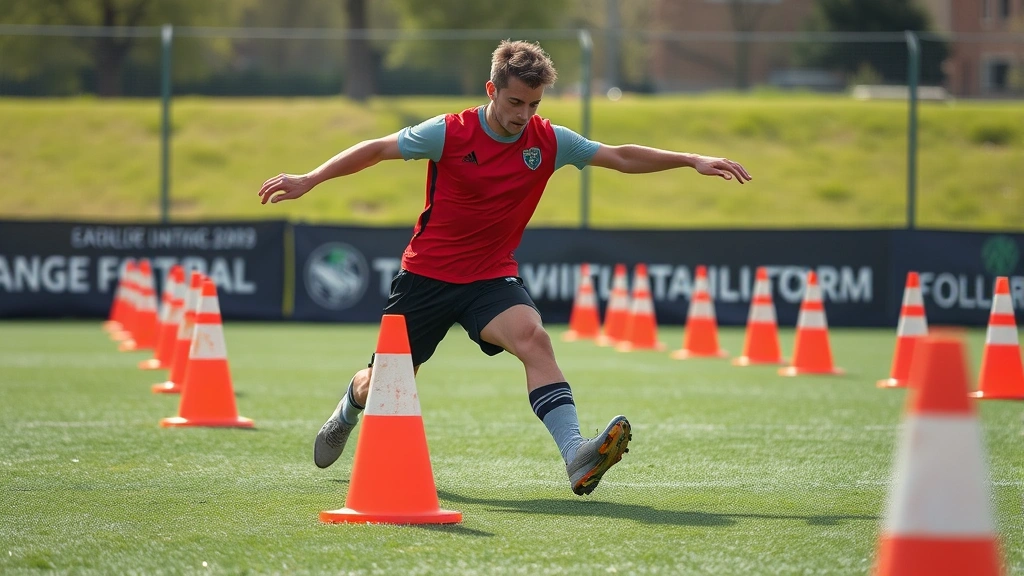
Cone Drills and Shuttle Runs develop change-of-direction ability essential for every position. The five-cone drill, T-drill, and pro-agility shuttle replicate game demands. Perform these drills 2-3 times per week with full recovery between reps. Focus on sharp plant-and-cut movements, maintaining low pad level, and explosive acceleration.
Sled Pushes and Backward Sled Drags strengthen the muscles used in acceleration while improving body positioning. Push a weighted sled forward for 20-30 yards, then drag it backward. This develops powerful hip extension and hamstring strength while reinforcing proper running mechanics. Execute 6-8 sets of 20-30 yards with heavy weight.
Resisted Sprint Training using bands or parachutes forces your nervous system to recruit maximum muscle fibers during acceleration. Sprint 20-30 yards with resistance attached, then immediately perform a non-resisted sprint to feel the difference in speed. Perform 6-8 sets of 20-30 yard sprints with 3-minute recovery between sets.
Ladder Drills and Footwork Patterns develop quick feet and coordination. High knees, lateral shuffles, and crossover steps through agility ladders improve foot speed and proprioception. Perform these drills 2-3 times per week for 30-45 seconds with maximum intensity, resting 30-45 seconds between sets.
Sport-Specific Movement Patterns
The best football training translates directly to game situations. While general strength and power are foundational, sport-specific movements cement your athleticism into football-specific excellence.
Quarterback-Specific Training emphasizes footwork, arm strength, and core stability. Three-step, five-step, and seven-step drop footwork drills develop consistency and rhythm. Medicine ball rotational throws and explosive pressing movements build throwing power. Incorporate fantasy football sleepers 2024 research to understand which physical attributes separate elite performers from backups.
Running Back Development requires explosive power, lateral agility, and lower body strength. Focus on single-leg balance exercises, lateral bound drills, and plyometric movements. Incorporate sled work and resisted sprints to build power for breaking tackles and accelerating through gaps.
Linebacker Training emphasizes lateral mobility, explosive power, and core strength. Lateral bounds, lateral sled drags, and lateral cone drills develop the side-to-side movement needed for coverage and run defense. Heavy squats and deadlifts build the strength to shed blocks and deliver powerful tackles.
Defensive Line Development prioritizes first-step explosiveness, upper body strength, and low pad level. Explosive push-ups, battle ropes, and heavy sled work develop the power and explosiveness needed to penetrate the line. Combine heavy strength work with explosive plyometric movements.
Wide Receiver and Cornerback Training emphasizes speed, agility, and vertical leap. Extensive plyometric work, sprint training, and cone drills develop the explosive athleticism these positions demand. Incorporate upper body strength work to enhance ball security and competitive ability in contested situations.
Injury Prevention and Mobility
Your training effectiveness means nothing if injuries sideline you. The most successful football players prioritize injury prevention through mobility work, proper movement patterns, and strategic recovery.
Hip Mobility and Flexibility prevent knee injuries and improve athletic performance. Perform dynamic hip mobility drills before training: leg swings, walking lunges, inchworms, and bodyweight squats. After training, dedicate 10-15 minutes to static stretching and foam rolling, focusing on hip flexors, glutes, and hamstrings.
Shoulder Health requires consistent mobility work and proper exercise selection. Incorporate band pull-aparts, dead bugs, and wall slides to strengthen scapular stabilizers. Avoid excessive bench pressing without balancing back work—maintain a 1:1 ratio of pressing to pulling movements.
Ankle Stability and Proprioception prevent ankle sprains and improve balance. Single-leg balance exercises, wobble board training, and lateral ankle mobility drills should be performed 3-4 times weekly. Strong, stable ankles directly correlate with improved athletic performance and injury resilience.
Review comprehensive strategies to avoid sports injuries for detailed injury prevention protocols specific to football athletes.
Programming Your Football Training
Randomly performing exercises produces random results. Strategic program design ensures progressive improvement and peak performance during the season.
Offseason Training (Phase 1: Building) focuses on developing maximum strength and power. Perform 3-4 days per week of strength training with heavy weights and low reps. Incorporate 2 days of explosive plyometric training and 3 days of conditioning work. Gradually increase training volume and intensity over 12 weeks.
Preseason Training (Phase 2: Power and Endurance) transitions from pure strength to power and sport-specific conditioning. Reduce repetitions while maintaining load, emphasizing explosive execution. Increase conditioning volume and complexity, incorporating sport-specific movements and game-speed drills.
In-Season Training (Phase 3: Maintenance and Injury Prevention) maintains strength and power while allowing recovery for competition. Perform 1-2 strength sessions weekly with reduced volume. Emphasize mobility work, activation drills, and recovery-focused activities. Prioritize quality sleep, nutrition, and stress management.
Sample Weekly Structure: Monday (Lower Body Strength), Tuesday (Speed/Agility), Wednesday (Upper Body/Core), Thursday (Sport-Specific/Plyometrics), Friday (Conditioning), Saturday-Sunday (Recovery). Adjust based on competition schedule and individual needs.
The National Council on Strength and Fitness provides evidence-based guidelines for periodized training programs that maximize athletic development while minimizing injury risk.
Progressive Overload Principle drives continuous improvement. Each week, aim to increase weight, reps, or intensity slightly. This progressive challenge forces your body to adapt and improve. Track your workouts meticulously—progression without measurement is impossible.
Recovery and Nutrition determine your training results more than the exercises themselves. Consume 1.6-2.2 grams of protein per kilogram of bodyweight daily. Sleep 7-9 hours nightly to allow muscle recovery and nervous system adaptation. Stay hydrated and incorporate active recovery days with mobility work and light conditioning.
Understand that sports team bonding activities complement individual training by building mental resilience and team cohesion—factors that enhance overall performance.

Monitoring and Assessment ensure your program remains effective. Test your forty-yard dash time, vertical leap, broad jump, and three-cone drill every 4-6 weeks. These objective measurements reveal whether your training is producing results. Adjust your program based on assessment data and feedback from your coaching staff.
Incorporate resources like college football predictions analysis to understand the physical attributes and movement qualities elite players possess, then reverse-engineer your training to develop those same characteristics.
Periodization Prevents Plateaus: Vary your exercise selection, rep ranges, and training intensity every 4-6 weeks. This variation prevents adaptation plateaus and maintains mental engagement. Rotate between heavy strength phases, hypertrophy phases, power phases, and endurance phases throughout the year.
Individualization is Essential: Your position, body composition, injury history, and natural strengths should influence your program. A 300-pound offensive lineman trains differently than a 170-pound cornerback. Work with a strength coach to customize your program based on your specific needs and goals.
FAQ
How often should football players train?
During the offseason, 4-5 days per week of structured training (combining strength, power, speed, and conditioning) produces optimal results. During preseason, maintain 3-4 training days. During the season, 1-2 maintenance sessions weekly preserve strength while allowing recovery for competition. Always include 1-2 complete rest days weekly for recovery.
What’s the best exercise for football players?
There’s no single best exercise—football development requires varied training. However, barbell back squats, trap bar deadlifts, and explosive plyometric movements consistently rank as most impactful because they develop the lower body power and explosiveness fundamental to football performance. Combine these with sport-specific movements relevant to your position.
Should football players do isolation exercises?
While compound movements should dominate your program (80-90%), isolation exercises serve important purposes. They address muscular imbalances, strengthen stabilizer muscles, and can prevent injury. Include 10-20% of your volume as isolation work, focusing on areas that need specific development based on your assessment data.
How does proper nutrition support football training?
Nutrition directly impacts training recovery, strength development, and athletic performance. Consume adequate protein (1.6-2.2g per kg bodyweight), carbohydrates for energy and recovery, and healthy fats for hormone production. Time carbohydrates around training for maximum performance. Proper hydration improves strength output and endurance capacity.
What’s the ideal training split for football?
A four-day upper/lower split or a five-day push/pull/legs split works exceptionally well for football players. These splits allow adequate training frequency and recovery while providing sport-specific emphasis. Example: Day 1 (Lower Power), Day 2 (Upper Strength), Day 3 (Speed/Agility), Day 4 (Lower Strength), Day 5 (Upper Power/Sport-Specific).
How important is speed training for football success?
Speed is critical but coachable. While genetics influence your ceiling, proper training improves your forty-yard dash time, acceleration, and change-of-direction ability significantly. Dedicate 15-20% of your training volume to speed and agility work, performing these drills when your nervous system is fresh (early in training sessions).
Can I train year-round without overtraining?
Yes, through strategic periodization. Vary your training intensity, volume, and focus throughout the year. Offseason emphasizes building strength and power. Preseason transitions to power and conditioning. In-season focuses on maintenance and injury prevention. This variation prevents overtraining while maintaining fitness.
What recovery methods accelerate adaptation?
Sleep is paramount—7-9 hours nightly allows muscle protein synthesis and nervous system recovery. Proper nutrition provides building blocks for adaptation. Active recovery (light walking, mobility work) enhances blood flow and reduces soreness. Massage, foam rolling, and ice baths may provide marginal additional benefits but don’t replace sleep and nutrition.


