Football Drills for Fitness: Coach Insights & Performance Gains
Football isn’t just a game—it’s a comprehensive fitness laboratory where elite athletes develop explosive power, cardiovascular endurance, and mental toughness. Whether you’re a high school player grinding through two-a-days or a coach designing your team’s conditioning program, understanding how football drills translate to measurable fitness improvements is essential. The intersection of sport-specific training and general fitness creates a unique opportunity to build athletes who dominate on the field while achieving fitness levels that rival dedicated gym enthusiasts.
Modern coaching emphasizes that every drill serves a dual purpose: skill development and physical conditioning. A simple cone drill isn’t just about footwork precision—it’s building aerobic capacity, anaerobic power, and neuromuscular coordination simultaneously. This article explores evidence-based football drills that maximize fitness gains, drawing insights from strength coaches, sports scientists, and field-tested methodologies that separate championship teams from the rest.

Why Football Drills Build Elite Fitness
Football demands unparalleled athleticism. Unlike isolated gym training, football drills develop integrated fitness—multiple energy systems operating simultaneously under game-realistic conditions. According to research from the American College of Sports Medicine (ACSM), sport-specific training produces superior cardiovascular adaptations and power output compared to traditional steady-state conditioning.
A typical football play lasts 4-6 seconds of maximum intensity effort, followed by 25-40 seconds of recovery. This interval structure mirrors high-intensity interval training (HIIT), one of the most effective fitness protocols for improving both aerobic and anaerobic capacity. The repeated-sprint nature of football means players develop exceptional lactate buffering—the ability to perform at high intensity despite metabolic stress.
Coaches who leverage Peak Play Arena Blog resources understand that fitness gains from football drills extend beyond the field. Athletes experience improved body composition, enhanced insulin sensitivity, stronger bones, and superior metabolic health. The explosive movements required in football activate fast-twitch muscle fibers and trigger significant hormonal responses that drive adaptation.
Essential Speed & Agility Drills
Speed separates elite players from average ones. However, raw straight-line speed matters less than change-of-direction ability—the capacity to decelerate, reorient, and accelerate explosively. This requires coordinated development of strength, power, proprioception, and sport-specific neural patterns.
The Pro Agility Shuttle (T-Drill)
This legendary drill develops lateral quickness and deceleration control. Players sprint 5 yards right, touch the line, sprint 10 yards left, touch, then sprint 5 yards right through the start line. Elite linemen complete this in under 5 seconds; skill position players target 4.5 seconds or faster.
Fitness benefits: Develops lateral explosive power, improves deceleration mechanics (critical for injury prevention), and builds multi-directional conditioning. The repeated directional changes tax both aerobic and anaerobic systems.
Cone Drills & Route Running
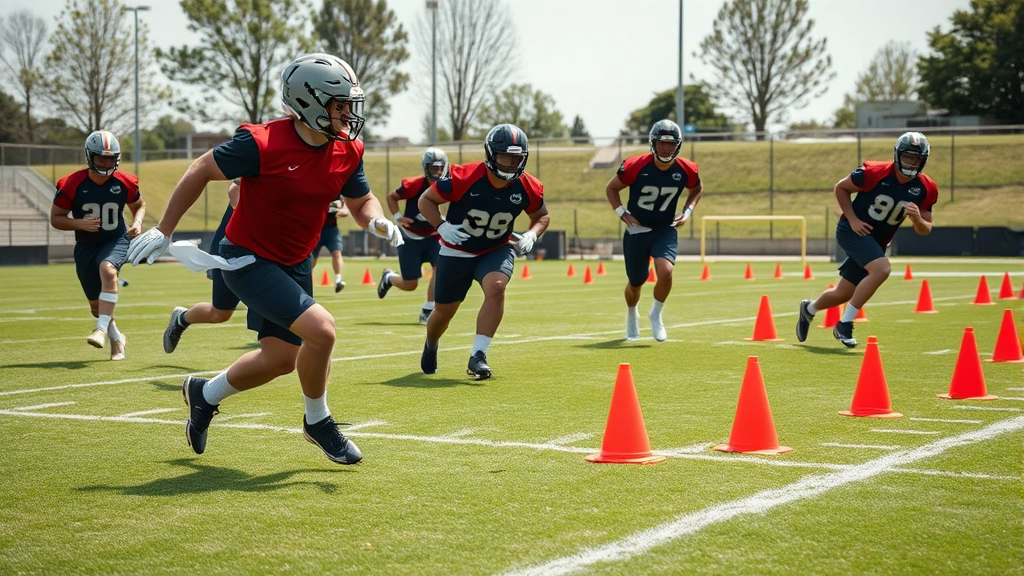
Setting cones in figure-eight, square, and diamond patterns forces players to navigate space while maintaining top speed. Wide receivers running specific routes—slants, posts, corners—train the exact movement patterns they’ll execute during games while building fitness through accumulated distance and intensity.
Advanced variation: Coaches add randomized directional cues, forcing players to react and adjust mid-drill. This develops decision-making speed and reactive agility—fitness components often overlooked in traditional conditioning.
Ladder Drills & Foot Coordination
Agility ladders develop foot speed, proprioception, and nervous system coordination. Drills like in-in-out-out patterns, lateral shuffles, and crossover steps improve the neuromuscular efficiency that translates to faster footwork in game situations. Though lower intensity than other drills, ladder work builds foundational movement quality essential for injury prevention and performance consistency.
Explosive Power Development
Football is a power sport. The ability to generate maximum force in minimal time—whether exploding off the snap, jumping for a catch, or breaking a tackle—determines competitive outcomes. Research from sports science journals confirms that explosive power is a trainable quality with direct transfer to performance.
Sled Push & Resistance Training Complexes
Heavy sled pushes (loaded 50-70% of body weight) develop lower body power and drive mechanics. Players perform 3-5 pushes of 15-20 yards, focusing on explosive acceleration. The resistance forces recruitment of maximum motor units while the shorter distances prevent excessive fatigue, allowing for quality execution.
Coaches combine sled work with plyometrics: players perform heavy sled pushes immediately followed by explosive unloaded jumps or sprints. This contrast training protocol potentiates the nervous system, producing heightened power output in the unloaded movement.
Plyometric Progressions
Box jumps develop lower body elastic strength. Players start with lower boxes (12-18 inches) and progress upward, aiming for maximum height with perfect landing mechanics. Proper landing—soft knees, neutral spine, centered weight—is critical for injury prevention and force dissipation.
Bounding drills train horizontal power and stride length. Single-leg bounds, alternating bounds, and bounds for distance develop unilateral power and address strength imbalances between legs. These drills also build eccentric strength—the ability to decelerate explosively, essential for preventing ACL injuries.
Reactive drills add complexity: medicine ball slams, rotational throws, and catch-and-throw combinations develop total-body power while mimicking football-specific movement patterns. These drills are particularly valuable for defensive linemen and linebackers who require explosive multi-directional power.
Conditioning Drills for Game Endurance
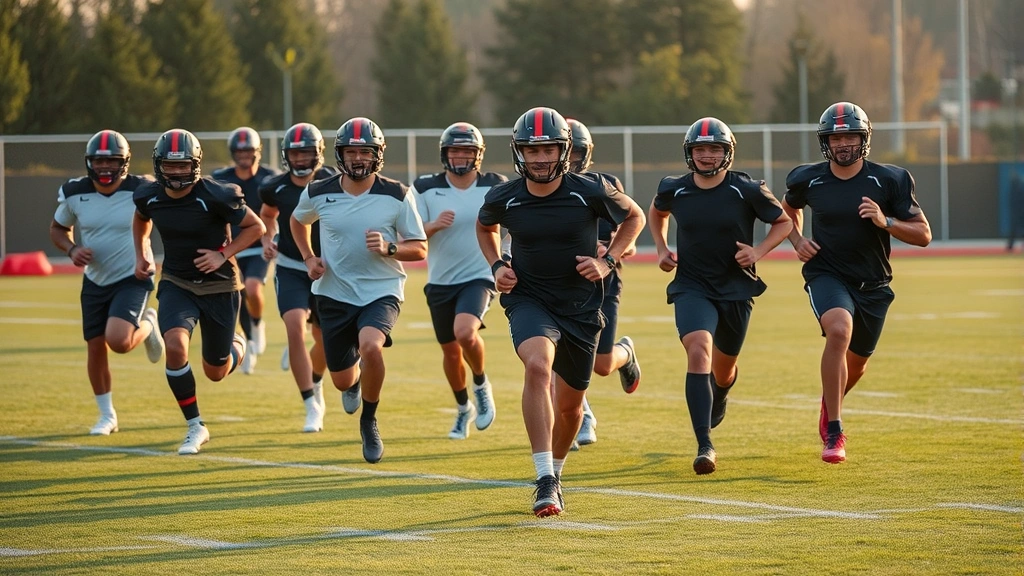
Fitness in football means sustaining elite performance across four quarters. Modern conditioning emphasizes sport-specific energy system training rather than monotonous long-distance running. Coaches structure conditioning around the actual demands of football—repeated high-intensity efforts with incomplete recovery.
Gasser Drills (Suicide Sprints)
The classic “gasser” involves sprinting to the near sideline, back to start, to the far sideline, and back to start—covering approximately 160 yards. Players perform multiple repetitions (3-6) with minimal recovery. This drill simultaneously develops aerobic capacity, anaerobic power, and mental toughness.
Coaches vary the distance and recovery to target different energy systems: shorter distances with longer rest periods emphasize power and ATP-PCr system recovery; longer distances with shorter rest periods stress aerobic capacity and lactate buffering.
Tempo Runs & Threshold Work
Sustained efforts at 85-90% maximum heart rate for 8-15 minutes develop the aerobic base essential for maintaining intensity throughout games. Coaches implement these as team conditioning, using varied terrain (field, stairs, grass) to prevent monotony while building resilience.
Position-Specific Conditioning
Linemen perform low-intensity sustained work with explosive bursts, mirroring the demand profile of their position. Skill position players perform high-intensity interval work with dynamic directional changes. This targeted approach ensures injury prevention while maximizing position-specific fitness adaptations.
Two-Minute Drill Simulations
Late-game scenarios demand peak performance under fatigue. Coaches simulate two-minute drills with full-speed execution, forcing players to maintain precision and intensity when muscles are fatigued. These drills build mental resilience and pressure tolerance while conditioning the nervous system to perform under stress.
Recovery & Injury Prevention
Elite fitness requires intelligent recovery. Football’s high-intensity nature creates significant muscle damage and nervous system fatigue. Coaches who prioritize recovery see improved performance, reduced injury rates, and better training consistency.
Active Recovery Protocols
Light movement on recovery days—walking, easy swimming, dynamic stretching—promotes blood flow and metabolic recovery without creating additional training stress. Research indicates active recovery accelerates lactate clearance and reduces delayed-onset muscle soreness (DOMS).
Mobility & Movement Quality
Tight hips, restricted shoulders, and poor ankle mobility predispose athletes to injury. Implementing daily mobility work—foam rolling, dynamic stretching, and movement pattern corrections—maintains movement quality even during high-volume training phases. This preventive approach is more effective than treating injuries after they occur.
Coaches reference How to Avoid Sports Injuries resources to implement evidence-based injury prevention strategies. Proper warm-ups, neuromuscular training, and progressive loading reduce injury risk by 20-50% depending on the specific intervention.
Sleep & Nutrition Optimization
Fitness gains occur during recovery, not during training. Elite programs mandate 8-10 hours of sleep and implement nutrition protocols supporting recovery: adequate protein (1.6-2.2g/kg body weight), carbohydrate timing around workouts, and micronutrient-dense whole foods.
Implementing a Complete Program
Successful football fitness programs integrate multiple drill types, progression schemes, and recovery strategies. A well-designed week balances high-intensity work, skill development, and recovery to maximize adaptation while preventing overtraining.
Weekly Structure Example
Monday: High-intensity speed & agility work (cone drills, T-shuttles), followed by explosive power (box jumps, sled pushes). Focus: nervous system activation and power development. Volume: moderate; Intensity: very high.
Tuesday: Skill work with integrated conditioning (route running, positional drills). Volume: high; Intensity: moderate-high.
Wednesday: Tempo conditioning and movement quality work. Volume: moderate; Intensity: moderate. Focus: aerobic base development and injury prevention.
Thursday: Sport-specific conditioning drills (gassers, two-minute scenarios) and plyometrics. Volume: high; Intensity: very high. This session prepares players for game demands.
Friday: Light skill work and active recovery. Volume: low; Intensity: low. Focus: preparation for game and nervous system recovery.
Progressive Overload Principles
Football fitness improves through systematic progression. Coaches manipulate variables: distance (longer sprints), intensity (faster times), volume (more repetitions), or complexity (reactive elements). Progressive overload prevents adaptation plateaus and ensures continuous improvement.
Tracking metrics—sprint times, rep max jumps, gasser completion times—provides objective feedback and motivation. Players see tangible fitness improvements correlating with on-field performance enhancement.
Checking College & High School Performance
Coaches monitor High School Football Scores and College Football Predictions to understand how program-specific fitness translates to competitive outcomes. Teams with superior conditioning typically maintain performance advantages in the fourth quarter, demonstrating the real-world impact of systematic fitness development.
FAQ
How often should football players perform high-intensity conditioning drills?
Elite programs implement 2-3 high-intensity sessions weekly, separated by at least 48 hours for nervous system recovery. More frequent high-intensity work increases injury risk and overtraining without additional benefit. The key is consistent, quality execution rather than excessive volume.
Can football drills replace traditional gym training?
Football drills and strength training are complementary. Drills develop sport-specific power and conditioning; structured strength training builds foundational strength, addresses imbalances, and prevents injuries. Comprehensive programs integrate both modalities strategically throughout the year.
What’s the best way to progress agility drills?
Progress by reducing time standards, increasing distance, adding reactive elements, or combining multiple drills without rest. For example, progress from stationary cone drills to reactive directional changes, then to sport-specific routes performed at game speed. This scaffolded approach builds competency while preventing injury.
How do football drills improve cardiovascular fitness?
The repeated-sprint nature of football drills produces significant cardiovascular adaptations. Short, high-intensity efforts stress both aerobic and anaerobic systems, improving VO2 max, cardiac output, and lactate threshold more effectively than steady-state cardio. Research confirms sport-specific interval training produces superior fitness outcomes.
What’s the relationship between football fitness and injury prevention?
Well-designed football programs build strength, power, proprioception, and movement quality—all protective factors against injury. Additionally, proper conditioning improves deceleration mechanics and eccentric strength, critical for preventing ACL and ankle injuries. However, quality execution matters more than volume; poor movement patterns at high fatigue increase injury risk.
How should players adjust drills for their position?
Linemen emphasize lower-body power and sustained effort drills; skill position players focus on directional agility and repeated-sprint ability; defensive backs prioritize lateral quickness and reactive agility. Tailoring drills to position-specific demands optimizes fitness while improving sport performance.
Football drills represent one of the most effective fitness training methodologies available. By understanding the science behind each drill and implementing systematic progression, coaches develop athletes who achieve elite fitness while mastering their sport. The integration of speed, power, conditioning, and recovery creates a comprehensive training approach that builds champions—on the field and in terms of overall athletic fitness.


