
6 Man Football Workout: Coach’s Insights for Peak Performance
Six-man football represents one of the most dynamic and demanding formats in competitive football. Unlike traditional 11-man football, the six-man game emphasizes speed, agility, and explosive athleticism across every position. As a coach working with six-man athletes, I’ve developed specialized training protocols that address the unique physical demands of this high-paced sport. The constant motion, minimal substitutions, and wide-open field require players to maintain exceptional cardiovascular fitness while developing sport-specific strength that translates directly to game performance.
The transition from traditional football to six-man play demands a complete recalibration of training methodology. Players must develop incredible work capacity since they’re on the field for significantly longer stretches without rotation. This comprehensive guide breaks down the essential workout components, training principles, and periodized programming that transform athletes into dominant six-man competitors. Whether you’re a player seeking to elevate your game or a coach designing your team’s training regimen, these evidence-based strategies will maximize your athletic potential and competitive edge.
Understanding Six-Man Football Demands
Six-man football operates under fundamentally different rules and spatial constraints compared to traditional football. With only six players per side on a smaller field, the game emphasizes continuous motion, rapid transitions, and sustained performance output. Players experience significantly higher movement demands, with studies from the American College of Sports Medicine indicating that six-man athletes cover 40-50% more ground during competition than their 11-man counterparts.
The positional demands in six-man football create unique athletic requirements. Every player must possess exceptional cardiovascular capacity, lateral mobility, and acceleration ability. Unlike traditional football where specialists occupy limited roles, six-man athletes must develop versatile skill sets enabling them to contribute on offense, defense, and special teams simultaneously. This multi-directional movement pattern, combined with minimal rest periods, creates metabolic demands that require specialized training approaches.
Understanding these demands forms the foundation for effective training design. Check out our high school football scores to see how six-man teams perform at competitive levels. The physical characteristics separating elite six-man performers include exceptional first-step quickness, sustained acceleration over 20-40 yard distances, and the ability to change direction explosively while maintaining balance and body control.

Speed and Agility Training Protocols
Developing elite speed and agility forms the cornerstone of six-man football training. These attributes determine competitive success more directly than in traditional football formats. Speed development requires a systematic approach addressing acceleration, maximum velocity, and deceleration mechanics. Acceleration work—the first 5-10 yards—proves most critical since six-man football involves constant directional changes and short-distance explosiveness.
Acceleration Training Components:
- First-step explosiveness through weighted sled pushes and resistance band sprints
- 10-yard acceleration repeats with 30-second recovery intervals
- Falling start drills emphasizing horizontal force production
- Block starts from various body positions simulating game situations
- Resisted acceleration work using partner resistance and parachutes
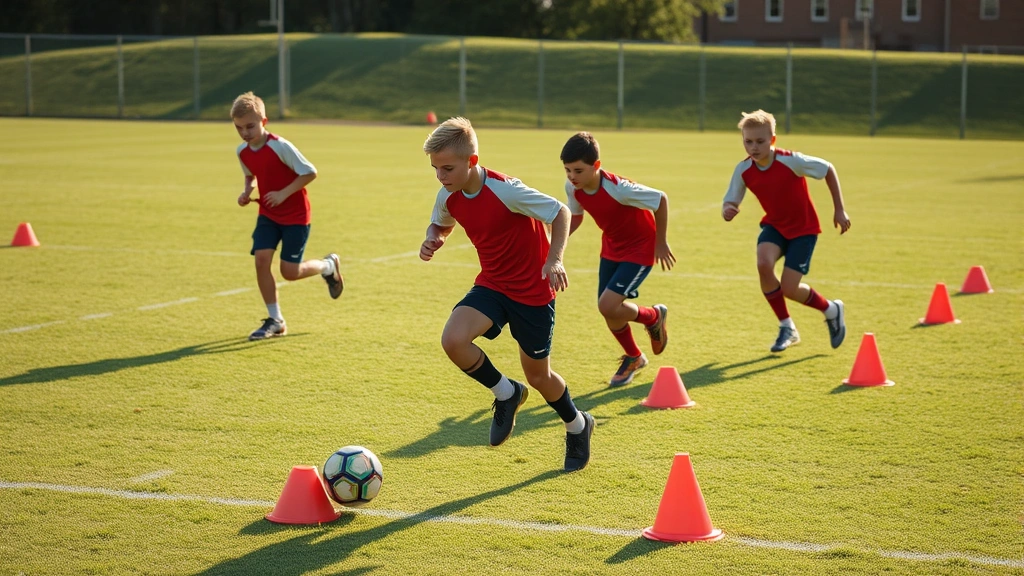
Agility training must address the multi-directional demands inherent to six-man competition. Traditional linear speed drills provide insufficient training stimulus. Instead, implement cone drills, shuttle runs, and sport-specific cutting patterns that mirror actual game movements. Research published in the Journal of Sports Sciences demonstrates that sport-specific agility training produces 23% greater performance improvements compared to generic agility work.
Advanced Agility Drill Sequences:
- Pro Agility Shuttle: 5-10-5 yard pattern completed for timed reps
- T-Drill: Addresses forward, backward, and lateral movement patterns
- Hexagon Drill: Six-direction agility circuit with rapid direction changes
- Three-Cone Drill: L-shaped pattern emphasizing acceleration and deceleration
- Sport-Specific Cuts: 45-degree, 90-degree, and 180-degree cuts at game speed
Implement these drills 2-3 times weekly during your training week. Prioritize movement quality over volume, ensuring athletes execute cuts with proper body mechanics. Poor cutting technique increases injury risk and limits performance gains. Video analysis of your athletes’ movement patterns enables coaches to identify mechanical deficiencies requiring correction.
Explosive Power Development
Power represents the product of force and velocity—the ability to generate maximum force in minimal time. Six-man football demands explosive power during tackles, blocks, jumps, and directional changes. Power development requires training the nervous system to recruit muscle fibers rapidly while building underlying muscular strength. The combination of heavy strength training and explosive plyometric work creates optimal power development stimulus.
Lower Body Power Exercises:
- Back squats: 3-5 sets of 3-5 reps at 85-90% maximum effort
- Trap bar deadlifts: Explosive triple extension emphasizing hip power
- Box jumps: 4-6 sets of 3-5 maximal effort jumps
- Broad jumps: 4-5 sets of 3 reps measuring distance progression
- Single-leg Romanian deadlifts: Unilateral strength and stability development
- Bounding drills: Multi-directional explosive movements
Upper body power development receives equal emphasis, particularly for players engaging in tackle situations and blocking assignments. Medicine ball throws, plyometric push-ups, and explosive rowing movements develop upper body power essential for six-man success. Research from exercise physiology journals indicates that upper body power correlates significantly with tackle effectiveness and blocking success.
Upper Body Power Progression:
- Medicine ball chest passes: 3-4 sets of 5-6 explosive reps
- Plyometric push-ups: 3-4 sets of 5 reps with maximum height
- Medicine ball rotational throws: Addressing rotational power demands
- Power rows: Explosive pulling movement development
- Landmine press throws: Single-arm explosive pressing patterns
Integrate power development into your training schedule strategically. Perform power exercises early in training sessions when the nervous system is fresh and capable of maximal effort. Never sacrifice movement quality for volume—one explosive, mechanically perfect repetition provides superior training stimulus compared to multiple sloppy repetitions.
Cardiovascular Conditioning Programs
Six-man football demands exceptional cardiovascular capacity. Players remain on the field for extended periods, requiring sustained high-intensity efforts throughout competition. Effective conditioning programming incorporates multiple energy system training approaches addressing aerobic capacity, anaerobic threshold, and repeated sprint ability.
Energy System Training Framework:
- Aerobic Base: Steady-state running 30-45 minutes at conversational pace, 1-2 times weekly
- Threshold Work: 20-30 minute efforts at 85-90% maximum heart rate
- Interval Training: High-intensity intervals with specific work-to-rest ratios
- Repeated Sprint Ability: Game-realistic sprint patterns with minimal recovery
Interval training protocols prove particularly effective for six-man athletes. These workouts develop the ability to maintain high performance despite accumulated fatigue. A sample interval session might include 8-10 repetitions of 30-second maximal sprints with 30-second recovery periods. As fitness improves, reduce recovery duration or increase work duration, progressively increasing training stimulus.
Sport-specific conditioning incorporates actual game movements rather than generic running. Shuttle sprints, directional changes, and position-specific movement patterns provide superior training transfer compared to traditional distance running. A comprehensive conditioning program balances different energy systems, preventing overtraining while maximizing performance adaptation.
Sport-Specific Strength Training
Building a strong foundation enables athletes to express power, resist injuries, and dominate in contact situations. Six-man football strength training emphasizes functional movement patterns applicable to game situations. Avoid isolated machine-based exercises favoring compound movements that develop multiple muscle groups simultaneously.
Essential Compound Movements:
- Back squats: Primary lower body strength developer
- Deadlifts: Full-body strength and posterior chain development
- Bench press: Upper body pushing strength
- Rows: Upper body pulling strength and back development
- Overhead press: Shoulder stability and upper body strength
- Lunges: Single-leg strength and stability
Program structure follows periodized training principles, cycling through different phases emphasizing various adaptations. A typical annual plan includes hypertrophy phases building muscle tissue, strength phases developing maximum force production, and power phases expressing that strength at high velocities. This systematic progression prevents plateaus and maximizes long-term athletic development.
Incorporate unilateral exercises addressing strength imbalances and developing single-leg stability. Six-man football demands single-leg strength during cutting, jumping, and deceleration movements. Single-leg squats, split squats, and single-leg deadlifts develop the stabilizer muscles and proprioceptive awareness essential for injury prevention and performance optimization.
Core strength receives appropriate emphasis, as core stability underpins all athletic movements. Planks, dead bugs, pallof presses, and rotational exercises develop the core musculature necessary for force transfer between upper and lower body. A strong core improves movement efficiency, reduces injury risk, and enhances athletic performance across all six-man football demands.
Recovery and Injury Prevention
Elite athletic performance depends equally on training stimulus and recovery quality. Six-man football’s demanding schedule requires comprehensive recovery strategies preventing overtraining and minimizing injury risk. Recovery encompasses sleep optimization, nutrition timing, active recovery techniques, and injury prevention programming.
Sleep Optimization Strategies:
- Maintain consistent sleep-wake schedules, even on weekends
- Target 7-9 hours nightly for optimal recovery and adaptation
- Minimize screen exposure 60 minutes before bedtime
- Create cool, dark sleeping environments promoting sleep quality
- Avoid caffeine consumption after 2 PM during heavy training phases
Nutrition timing profoundly impacts recovery and adaptation. Consume protein and carbohydrates within 30-60 minutes post-training, providing amino acids for muscle repair and carbohydrates for glycogen repletion. Daily protein consumption should target 1.6-2.2 grams per kilogram of body weight, distributed across multiple meals. Proper hydration supports thermoregulation, nutrient transport, and cognitive function—critical components of six-man football performance.
Active recovery sessions maintain movement quality while promoting blood flow without imposing significant training stress. Light jogging, swimming, yoga, and mobility work serve as active recovery modalities. These sessions should feel easy, allowing athletes to recover while maintaining movement patterns. Schedule active recovery days between intense training sessions, particularly during competitive seasons.
Injury Prevention Components:
- Dynamic warm-up protocols addressing mobility and activation
- Movement screening identifying movement deficiencies
- Eccentric strength training building resilience to injury
- Proprioceptive training enhancing balance and body awareness
- Flexibility and mobility work maintaining range of motion
- Sport-specific prehabilitation addressing common six-man injuries
Implement a comprehensive warm-up protocol before every training session and competition. Dynamic stretching, movement preparation exercises, and sport-specific activation prepare the nervous system and musculature for intense activity. This 10-15 minute protocol reduces injury risk while improving performance readiness. Learn more about football gloves and other equipment considerations supporting performance.
Monitor athlete wellness through subjective and objective measures. Resting heart rate, heart rate variability, and perceived exertion ratings provide insight into recovery status and training readiness. Athletes reporting elevated fatigue, persistent soreness, or performance decrements may require training volume reduction and increased recovery emphasis. Overtraining prevention ensures sustained performance improvements throughout the season.
FAQ
How many days per week should six-man athletes train?
Elite six-man athletes typically train 4-5 days weekly, combining strength training, power development, speed/agility work, and conditioning. This frequency provides sufficient training stimulus while allowing adequate recovery. Incorporate 1-2 active recovery days and 1 complete rest day weekly. During competitive season, adjust training volume based on game schedule and competition demands.
What’s the optimal rep range for six-man football strength training?
Vary rep ranges throughout training cycles. Strength phases emphasize 3-5 reps at 85-90% effort, hypertrophy phases utilize 6-12 reps at moderate weight, and power phases employ 3-5 explosive reps. This variation optimizes different physiological adaptations while preventing training monotony and plateaus.
How should I structure conditioning workouts during competitive season?
During competitive season, reduce conditioning volume slightly while maintaining intensity. Implement 2-3 conditioning sessions weekly, incorporating interval training and repeated sprint work. Keep sessions shorter (15-20 minutes) than off-season conditioning, preventing excessive fatigue during competition weeks. Prioritize movement quality and game-specific patterns.
What’s the best approach for position-specific training in six-man football?
While all six-man athletes require general athletic development, position-specific programming addresses unique demands. Review our 2024 Prizm Football resources for contemporary insights. Receivers emphasize lateral agility and explosive acceleration, linemen focus on lower body strength and power, and defensive backs prioritize change-of-direction ability and repeated sprint capacity.
How can I prevent overtraining during six-man football season?
Monitor training volume, intensity, and frequency systematically. Implement periodized programming with planned recovery weeks reducing training stress by 40-50%. Track athlete wellness metrics including resting heart rate, sleep quality, and subjective fatigue ratings. Reduce training volume immediately if athletes exhibit persistent fatigue, performance decrements, or illness susceptibility. Prioritize quality over quantity—strategic, focused training outperforms excessive volume.
What role does nutrition play in six-man football performance?
Nutrition fundamentally impacts recovery, adaptation, and performance. Consume adequate protein (1.6-2.2g/kg), carbohydrates supporting training demands, and healthy fats supporting hormone production. Time nutrient intake strategically around training sessions, emphasizing post-workout nutrition within 30-60 minutes. Stay hydrated throughout the day, consuming 16-20 ounces of fluid per pound of body weight lost during training. Consult sports nutrition professionals for individualized recommendations.
How do I develop six-man football specific conditioning?
Design conditioning workouts incorporating actual game movements and intensity patterns. Analyze six-man football demands through competition video, identifying typical sprint distances, work-to-rest ratios, and movement patterns. Create conditioning protocols replicating these demands—perhaps 30-second high-intensity efforts followed by 30-second recovery periods. Sport-specific conditioning provides superior transfer compared to generic fitness training. Visit our Peak Play Arena Blog for additional training insights and resources.
What’s the importance of mobility and flexibility for six-man athletes?
Mobility and flexibility support injury prevention, movement quality, and performance capacity. Implement dynamic stretching before training sessions and static stretching post-workout. Address common movement limitations through targeted mobility work—hip mobility, thoracic rotation, and ankle mobility prove particularly important. Allocate 10-15 minutes daily to mobility work, progressively improving range of motion throughout the training year.
How should athletes progress training intensity throughout the season?
Follow periodized progression principles, increasing training stress gradually. Early off-season emphasizes base development with moderate intensity and higher volume. As competition approaches, reduce volume while increasing intensity through heavier loads and faster movements. During competitive season, maintain intensity while reducing volume. Post-season allows complete recovery before the cycle repeats. This systematic progression prevents plateaus while optimizing performance timing.


